

M6 Reinvents Itself in the Age of Platforms
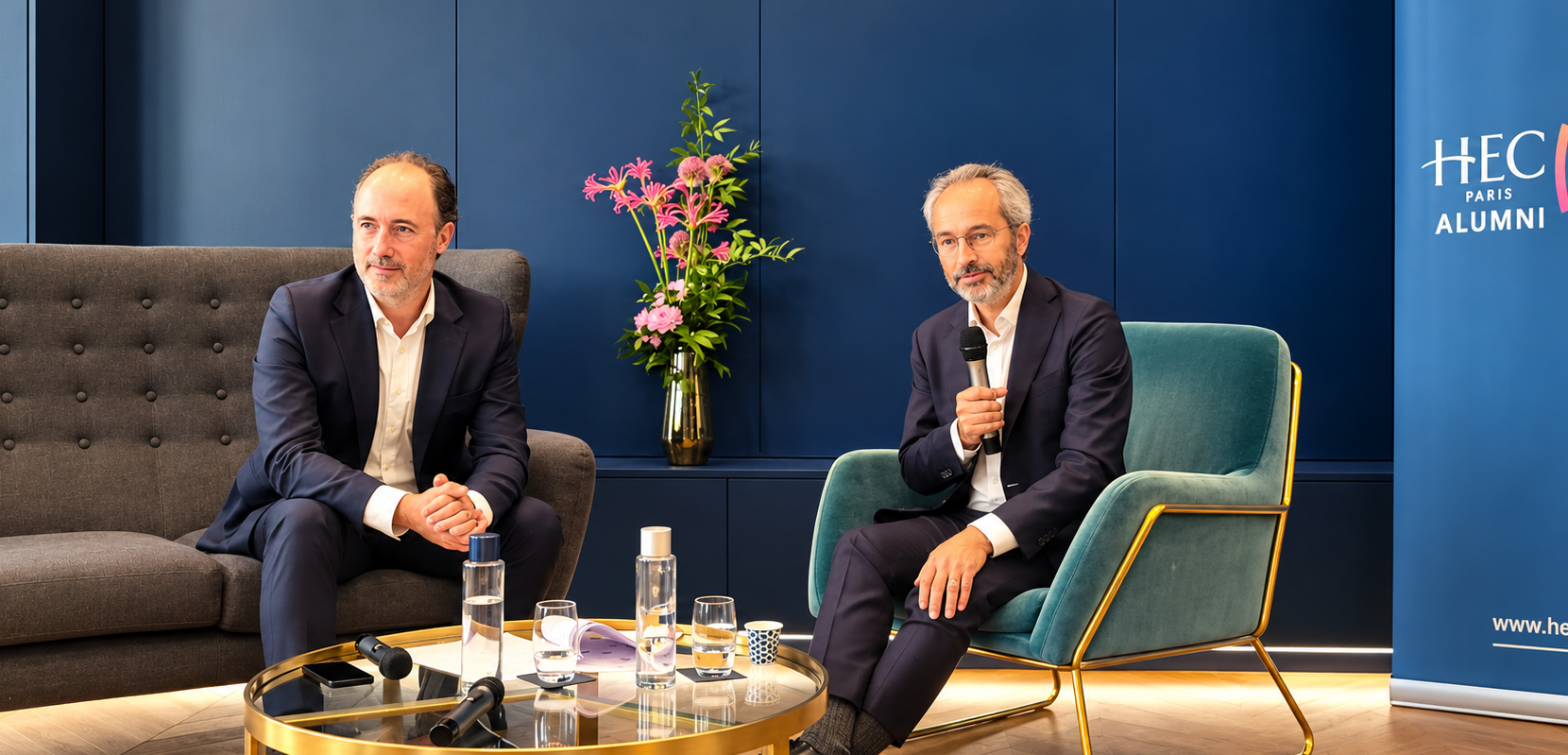
At a gathering dedicated to the transformation of the M6 Group, Mathieu Besson (EMBA.23 Media & Entertainment Club member) welcomed David Larramendy, Chairman of the Group’s Management Board since 2024. Speaking to participants, the executive discussed the upheavals reshaping the audiovisual landscape: the rise of streaming, the growing power of global platforms, changing viewing habits, and the increasing influence of algorithms. How can a historic television group carve out a place in this new battle for attention? And how can it continue to bring people together as content becomes increasingly personalized? From M6+ to partnerships with streaming giants, David Larramendy outlined the strategic choices of a group seeking to transform its business model without giving up what makes television so powerful.
An engineer by training, with degrees from CentraleSupélec and Wharton, David Larramendy joined M6 in 2008 through a somewhat unexpected entry point: sales and teleshopping. He went on to become CEO of M6 Publicité at the end of 2014, joined the Group’s Management Board a few months later, and became Chairman of the Group in April 2024, succeeding Nicolas de Tavernost after 37 years at the helm. A business-focused executive, in other words, taking charge of a group whose core business remains fundamentally about content and audiences, at a time when the rules of the audiovisual industry are being radically rewritten. “Our job is to entertain and to inform all French people,” he says. M6 has been doing so since 1987. Around its flagship channel, the Group has expanded into radio with RTL, cinema, production, distribution, several television channels, and streaming with M6+.
When Viewers Are No Longer Really Choosing
For decades, television operated according to a simple principle: appointment viewing. A channel selected a program and a time slot, and viewers knew where and when to find it. The arrival of streaming changed that logic by allowing viewers to choose when they wanted to watch. M6 launched its catch-up service as early as 2008, before Netflix and other platforms made on-demand viewing mainstream. But according to David Larramendy, a third revolution is now underway: the algorithm.
The shift is no longer simply about when we watch content, but about how that content reaches us. On social media and certain platforms, users are no longer necessarily choosing what they watch: algorithms analyze their previous behavior and continuously serve them new content. We have moved from appointment viewing to on-demand viewing, and from on-demand to recommendation—or even automated consumption.
For audiovisual groups, the shift is substantial. It is no longer enough to produce a program strong enough to bring viewers together at 9 p.m. They must exist in an environment where television, streaming, social media and digital content are all competing for the same minutes of attention. According to David Larramendy, M6 Group content generated more than 15 billion video views on social media in 2025. That is considerable visibility, but its economic impact remains very limited compared with the Group’s traditional activities. This is the paradox of the new attention economy: reaching more people does not necessarily mean creating more value.
Four Million New Accounts—What Comes Next?
M6+ is at the heart of this transformation. For a long time, the streaming platforms operated by traditional broadcasters were primarily seen as a way to catch up on missed programs. Today, they are becoming destinations in their own right. According to David Larramendy, the Group’s major entertainment brands now generate a significant share of their viewing on M6+, alongside their linear broadcasts.
The FIFA World Cup provided a striking illustration, with 4.2 million accounts created on the platform during the competition, bringing the total number of M6+ accounts from around 20 million to 24 million. But acquiring users is only the first step. Unlike Netflix, whose model is based on subscriptions, M6+ operates primarily on a free, advertising-funded model. A Netflix subscriber who pays every month continues to generate revenue even if they do not watch a program. An M6+ user who does not return to the platform generates no advertising exposure. “It’s like riding a bike,” David Larramendy explains: if you stop pedaling, the model stops working too.
The challenge, therefore, is to turn a user who comes for an exceptional event into a regular visitor—someone who comes back for a series, a documentary, an entertainment show, or the news. This shift is also transforming advertising. David Larramendy explains that an hour watched on M6+ now generates roughly as much revenue for the Group as an hour of linear television, even though the platform carries around half as much advertising. The difference lies in data: digital viewing provides deeper insight into audience behavior and makes it possible to refine campaign targeting. Data from M6+ can also be enriched with information from partners to offer advertisers more precise audience segments. Digital technology therefore does not simply change the screen on which a program is watched; it also changes the economic value of every hour of viewing.
The New Remote Control
There remains one essential question: before convincing someone to watch an M6 program, you first have to appear on their screen. When viewers turn on a traditional set-top box, television channels naturally occupy a central position. On a TV connected directly to the Internet, the landscape is different: Netflix, Amazon Prime Video, Disney+ and other apps become the main gateways to content. For a traditional broadcaster, the risk is that it may no longer even be among the options considered by the user. David Larramendy sums up M6’s strategy in one phrase: “We need to be in every menu.” That is the logic behind M6+’s integration into the Amazon ecosystem. The partnership may seem paradoxical, since these platforms are also direct competitors in the battle for screen time and advertising budgets. David Larramendy describes them as “frenemies”: players that are both competitors and partners, and which have become too important to ignore.
Under the agreement presented during the event, the M6+ offering remains clearly identifiable, with live channels and the Group’s content available within the Amazon ecosystem, while M6 retains, among other things, responsibility for selling advertising space. The Group has also developed a relationship with Disney around several pieces of content, with the ambition of gradually expanding its presence. The battle for attention is therefore also a battle for distribution: being present wherever viewers are likely to choose what they are going to watch. YouTube, however, is a different case. M6 distributes some of its content there, but David Larramendy highlights the economic imbalance between the audiences generated and the revenues they produce. The issue is therefore not visibility, but how value is distributed. For a group that buys or produces programs, not all views are created equal. Behind the race for audiences lies another question: where are programs being watched, and who captures the value created by that attention?
Millions of Screens—but Is There Still Something We Can Watch Together?
Beyond the economic challenges, this transformation raises a deeper question: as viewing habits become increasingly individualized, what remains of television’s ability to create shared experiences? For David Larramendy, this is precisely where traditional media retain a particular strength. A major sporting event, an entertainment show or a live broadcast is not simply content consumed individually. These programs become collective experiences, watched with family or friends, discussed the next day, and capable of giving millions of people a shared point of reference. The FIFA World Cup is, in his view, one of the clearest examples. Despite the proliferation of screens and viewing options, certain programs are still capable of bringing large audiences together.
This ability to bring people together takes on particular significance in an increasingly personalized media environment. In traditional television, several million people may receive the same information and interpret it differently. With algorithm-driven feeds, the content itself can vary from one user to another. David Larramendy points to the risk of confirmation bias: the more a user consumes a particular type of content, the more algorithms may offer them similar content. Two people can therefore be exposed to very different representations of the same issue. For the executive, this fragmentation increases the responsibility of major media organizations and their ability to preserve shared spaces.
Is Television Dead? Not So Fast
This may be where M6’s most important transformation is taking place. The Group must become a platform without ceasing to be a broadcaster; harness data without losing the power of mass audiences; collaborate with international giants without handing over all the value generated by its content; and use social media to reach new audiences while preserving its own business model. Above all, it must continue to create moments that bring people together in a world that once seemed determined to move beyond them. Television is not necessarily disappearing—it is changing its boundaries. Yesterday, the battle was about being the channel viewers selected from among a handful of buttons on the remote control. Today, it is being fought between a channel, a platform, an app, a social media video and an algorithmic recommendation.
In this new media landscape, M6’s challenge is no longer simply to know what French audiences will watch tomorrow, but to remain present wherever their eyes—and their attention—will land.

Published by Lionel Barcilon