

Charles Cheng (MBA.89), the Man Who Travels Between Worlds
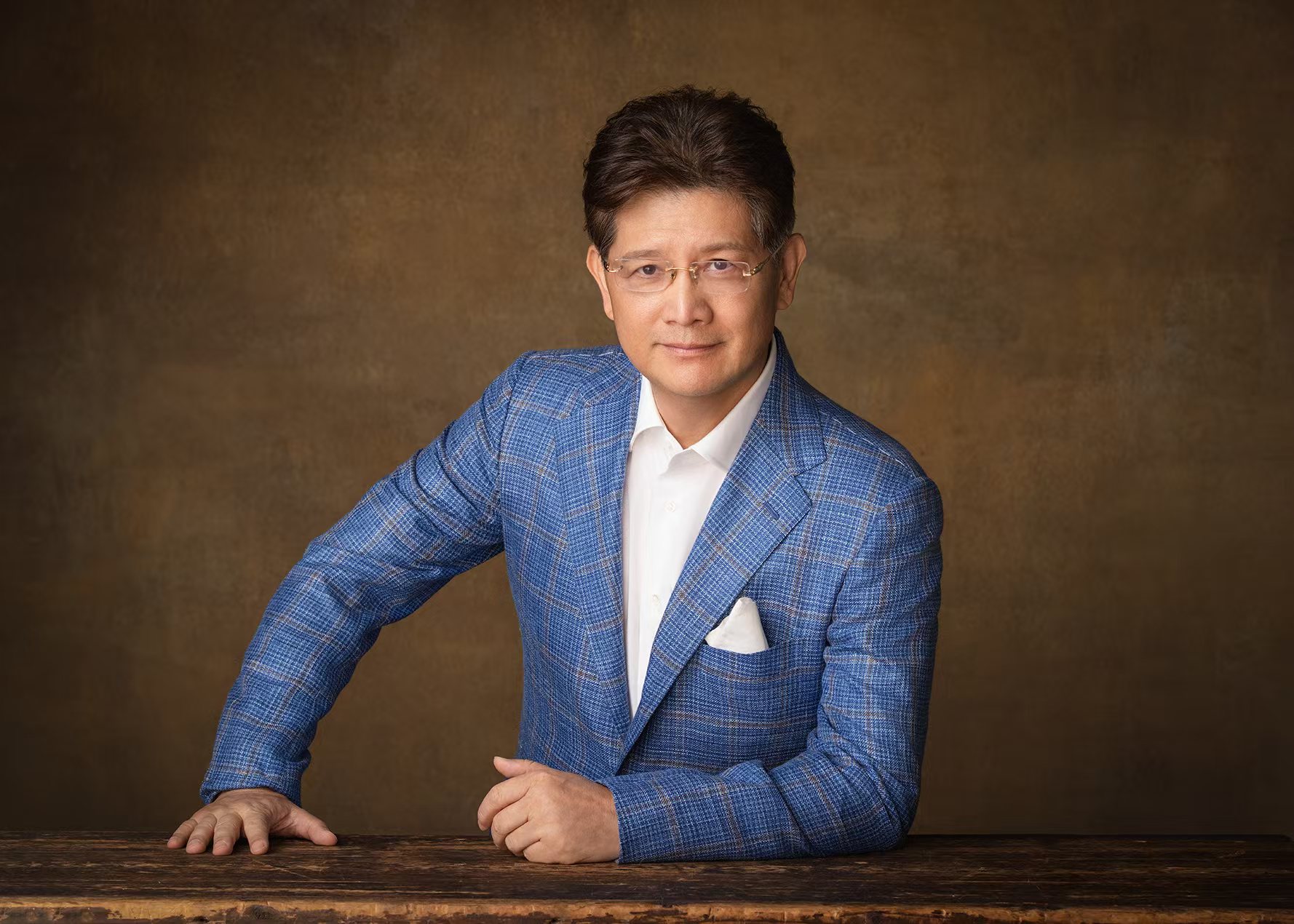
From China to Paris, from Montreal to Chicago, from JPMorgan to Goldman Sachs and then Société Générale, Charles Cheng has spent his professional life crossing borders. But his real field of exploration lies above all in the differences between cultures, perspectives and ways of doing business. We meet a leader for whom understanding others is less a personal quality than a working method.
On this rainy September day, the InterContinental is buzzing with activity. The South Korean head of state is staying there, security teams are everywhere, and the usual flow of people has been disrupted. In this almost theatrical setting, Charles Cheng arrives with understated elegance: dark suit, neat appearance, calm smile. Nothing about him seems rushed.
In smooth, precise French, occasionally punctuated by brief hesitations as he searches for exactly the right word, the businessman tells his story, backtracks, interrupts himself to clarify an idea. And above all, he travels extensively through his memories. Montreal, Toronto, Chicago, Hong Kong, Beijing, Paris, London, New York, Singapore… as well as Sydney, Melbourne, Auckland and New Zealand. The cities unfold like so many chapters of the same story.
His Chinese name is Chang-Qing Cheng (成长青). “Charles” came later. When he arrived in North America, his Chinese first name was difficult to pronounce. Charles worked in both English and French. He adopted it. The choice may seem anecdotal. Yet it says a great deal about a man who, for nearly forty years, has constantly learned to move from one world to another without ever allowing himself to be confined to just one.
Today, Charles Cheng is Chairman of the Board of Société Générale in China, he sits on the bank’s board of directors. He previously headed its investment banking operations in China, following a long career in Anglo-Saxon investment banking. But when he talks about his career, he starts neither with titles nor transactions, but with people.
Paris, or Learning to Understand Others
In the 1980s, the young Chang-Qing arrived in France. He still spoke the language imperfectly and discovered a country whose codes he did not know, as well as a system of grandes écoles that was completely foreign to him. He could have stayed within the Chinese community, but chose to look elsewhere. “I told myself that I had to immerse myself in French culture. I didn’t want to stay with Asians every day, cooking Chinese food. Otherwise, that’s not me.” So he immersed himself. Literally. He made French friends, spent time with their families, discovered their habits, their conversations and their ways of thinking. At the Cité Universitaire, in Paris’s 14th arrondissement, he met a shopkeeper who was initially just the customer who bought a few tomatoes and a few other odds and ends. A relationship developed. She regularly invited him, along with her four children, to the Théâtre du Châtelet or the Hôtel de Ville. He remembers those moments with almost childlike affection. In his eyes, these were not peripheral details of his journey, but precisely the experiences that enabled him to understand France. He also met young French people who welcomed him into their homes and introduced him to their families. He observed, listened and asked questions. Little by little, he came to understand HEC, ESSEC, the grandes écoles and their entrance exams. HEC then became much more than a degree. Charles Cheng completed his MBA there from 1987 to 1989.
Four decades later, he still speaks of that period as a foundation. “France and HEC gave me a great start, a very good foundation,” he explains. A foundation built on logic, structure and an understanding of the business world, but also on culture: how do a society, a history and a political system influence the way business is conducted? This is probably where the guiding thread of his career began to emerge. For Charles Cheng, understanding business never means simply understanding a market. You have to understand the people who make it work. And to understand people, you have to be willing to change your own perspective.
From Montreal to Beijing, Building a Borderless Career
After HEC, the professional world did not immediately open its doors to him. He went to North America and chose Montreal as his first stop. The city was bilingual: for him, it was an ideal transition between France and the English-speaking world.
The choice was bold. At the time, HEC Paris was still little known in North America. After an exchange semester, he looked for a job and faced a series of rejections. Eventually, a company offered to help him with his administrative procedures. He began his banking career in Montreal, then moved on to Toronto and Chicago, spending around six years in North America. He sums up this period with a phrase that sounds very much like him: “It was a step back to leap forward.”
Then came acceleration. He joined JPMorgan in Chicago and continued his career in investment banking. Standard Chartered became a major chapter from 2002 onward. The young executive worked on international transactions, advised Chinese companies on acquisitions and found himself at the heart of the country’s economic opening. In 2007, he was appointed CEO of Standard Chartered’s Investment Banking China. He describes this period as an exceptional moment. China was opening up. Private companies were gaining strength. State-owned enterprises were being reformed. International flows were multiplying. And Charles Cheng found himself precisely where different worlds were beginning to meet.
Among the transactions that marked this period, he recalls advising a Chinese company on what was then the largest Chinese investment in Africa, worth nearly US$2.7 billion in 2006. Following the transaction, CCTV named him one of China’s “10 Most Influential Financiers of the Year.”
He travelled constantly. France, Africa, Canada, Hong Kong, London, New York, Singapore, as well as Sydney, Melbourne, Auckland and New Zealand. “A lot of travelling. A very intense life,” he recalls, as though he has forgotten none of it.
Investment banking, he says, is almost a “physical test.” A day can begin at six in the morning with a meeting about the markets, continue with a succession of meetings with investors and end on a plane to another financial centre. This nomadic life had a deeper effect than simply building endurance. After crossing so many borders, Charles Cheng gradually stopped looking at the world from a single vantage point. “I’m a traveller,” he says, before adding: “There are other things in the world.”
America taught him about those “other things.” France gave him an intellectual and cultural framework; America taught him comparison. He discovered different ways of doing business, different relationships with time, authority and risk. “I need to know how to understand,” he says. In 1996, he returned to China with JPMorgan, where he spent four years managing a portfolio of corporate clients. Charles Cheng returned to a country undergoing profound transformation and felt he had arrived at the right moment. “I was lucky. It was the right time to return to China.” This notion of luck comes up repeatedly in his story. But in his case, luck seems less the opposite of strategy than its complement. You have to recognize the right moment, and then have travelled enough to understand what it means. In 2012, he became Managing Director of Goldman Sachs Gao Hua Securities, and then headed Goldman Sachs’ investment banking business in China. He remained there until 2017.
Risk, Failure and the Art of Decision-Making
His career could give the impression of a perfectly linear ascent, but it was not. In 2018, Charles Cheng left Goldman Sachs to join BYTON, a young Chinese electric vehicle manufacturer, as co-chairman. He was notably responsible for strategy and fundraising. Within a few months, he helped raise US$700 million. Then the project failed. He says so himself, without hesitation: “It was a failure experience.”
This episode is revealing of the way he talks about business. No dramatization. No attempt to rewrite history. Failure is part of the journey.
In investment banking, he learned to allocate resources, assess probabilities and know when to continue and when to stop. He talks in particular about transactions in which several banks compete for the same client: you can devote an enormous amount of time to a deal that ultimately goes to another team. The problem is not simply losing. It is losing too often and wasting the company’s resources. In his view, decision-making therefore rests on constant judgment: knowing where to invest your time, your energy and your capital. This philosophy also seems to guide his approach to management.
After two decades in Anglo-Saxon environments, he learned to adapt the way he expressed an opinion, spoke to others and led. Someone who describes himself as very direct, he had to learn to listen to cultural differences before reaching his own conclusions. This may be one of the great lessons of his career: international experience is not simply about becoming multilingual and collecting passports. It is about understanding that the same gesture, the same sentence or the same decision will not necessarily have the same effect depending on where you are.
In 2020, Charles Cheng joined Société Générale, and in March 2021 he was appointed Chairman for China. For him, it was an unexpected kind of homecoming. His career had largely been built at British, Canadian and American banks. Société Générale was his first truly French banking experience. And he makes no secret of his pleasure: “I was very happy,” he says, with the humility that characterizes him.
HEC, of course, is part of this story. His knowledge of France, his French culture, his command of the language and his international experience make him a natural bridge between the two worlds. But he never presents his career as a fixed Franco-Chinese identity. Instead, he sees himself as someone who has learned to belong to several worlds without needing to choose between them.
Bringing Perspectives Together
This is undoubtedly what best explains his involvement with HEC Paris. Since 2017, Charles Cheng has served on the School’s International Advisory Board. Invited by Peter Todd, then Dean of the School, he has taken part in discussions about its international strategy, positioning and, in particular, its development in China. He describes the role as a two-way exchange: bringing his experience while also understanding the School’s needs and thinking about how HEC can continue to build bridges. The subject clearly matters to him. He also supports Chinese executives visiting France for the first time. And he recounts their questions, sometimes surprised by strikes, public debates and French habits. He sees these experiences less as a culture shock than as an opportunity to learn. His ambition is ultimately simple: to put people “in the other person’s shoes.” To understand why the French react the way they do. To understand why the Chinese do the same. And, above all, to accept that people can disagree without ceasing to seek understanding. “How are we going to find a common destiny?” he asks. Then he formulates the answer in the vocabulary of a traveller: “To be able to navigate and manage differences.”
The word “navigate” suits him well. Charles Cheng has spent his professional life moving from one country to another, from one bank to another, from one culture to another. He has experienced the great houses of international finance, the exhilarating years of China’s economic opening, the pressure of the markets, nights spent on airplanes, successful transactions and companies that failed. But when he looks back on his career, it is not the billions raised or the titles held that seem to matter most. It is the people.
A shopkeeper in Paris’s 14th arrondissement. A French family who welcomed him on weekends. A friend who introduced him to the grandes écoles. An American colleague. Chinese bankers. European executives. German entrepreneurs. HEC students. All these encounters have built something that appears on no résumé: the ability to look at the world from several places at once.
At a time when relations between China, France, Europe and the United States are becoming more complex, this ability takes on particular significance. The business world is no longer simply a space of financial flows and markets, but also a space of perceptions, mistrust and sometimes contradictory narratives. Charles Cheng does not claim to erase these differences. Instead, he prefers to learn how to navigate between them.
And perhaps that is ultimately the best definition of his career: not choosing between China and France, between Asia and the West, or between different cultures, but turning his position between worlds into a professional strength. An art of navigation, in a word.

Published by Daphné Segretain