Hinda Gharbi at HEC Morning Talks: The CEO Who Wants to Certify the AI World
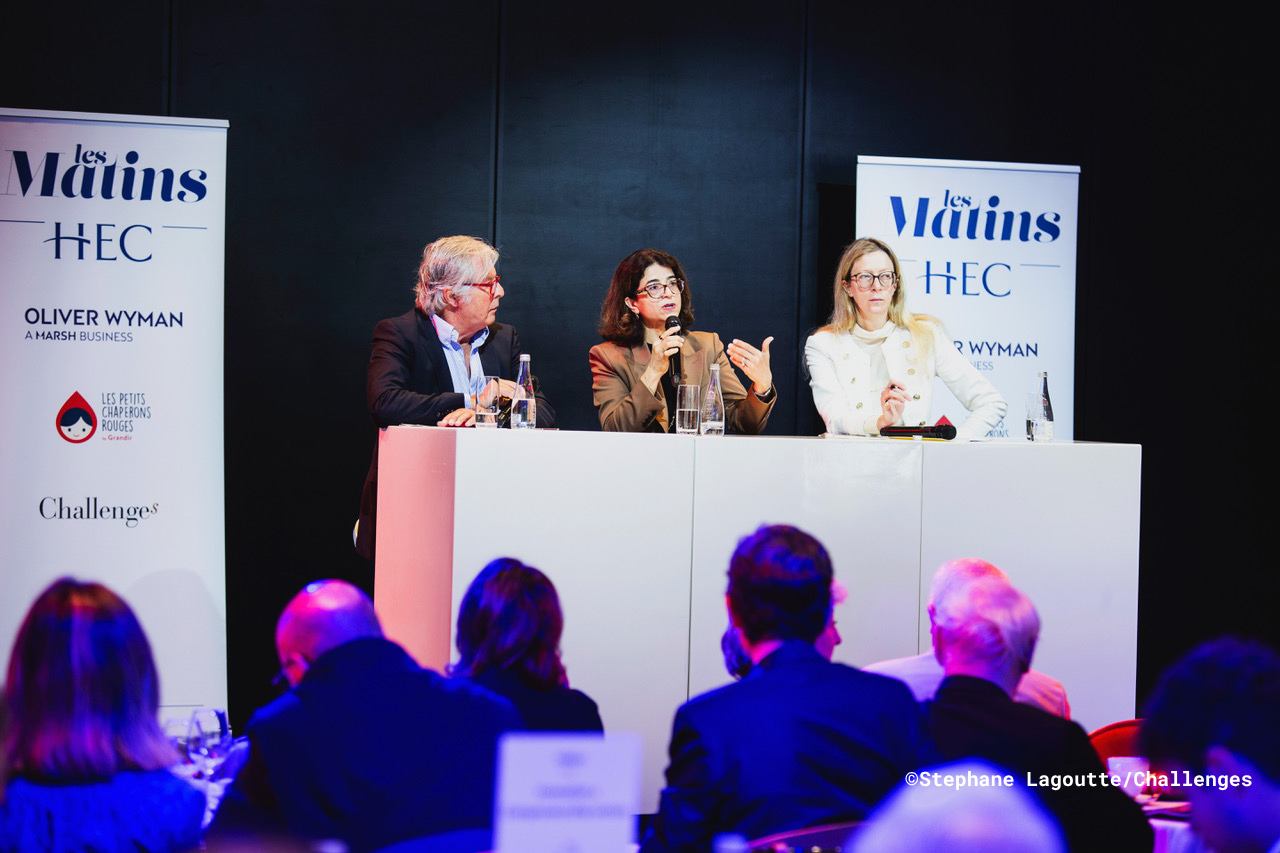
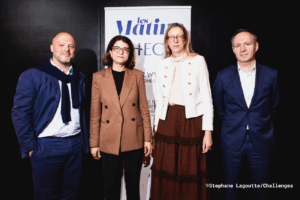
“Globalization has not disappeared; it has been reconfigured.” Speaking at the 348th HEC Morning Talk on June 9, Bureau Veritas CEO Hinda Gharbi shared her vision of a world where supply chains are shifting and artificial intelligence (AI) is transforming entire professions. At the helm of one of the world’s leading testing, inspection, and certification companies, the engineer by training aims to turn the nearly 200-year-old French group into a key player in the digital economy.
For Hinda Gharbi, geopolitical tensions have not brought globalization to an end. Instead, they have redirected global flows. For decades, companies pursued lower costs by relocating production to Asia, particularly China. Today, however, supply chain resilience, industrial sovereignty, and proximity to markets have become decisive factors. Positioned at the heart of these transformations, Bureau Veritas helps major corporations redesign their supply chains. Based in Paris, Gharbi has observed a gradual shift of manufacturing capacity away from China over recent years. “Companies are still looking for cost efficiency, but they are also looking for value,” she summarizes.
Certifying AI
Bureau Veritas built its reputation by certifying ships, factories, and industrial products. “Whether you ride the Riyadh Metro, visit the Shanghai Planetarium, the Fondation Louis Vuitton, or attend a concert at the Philharmonie de Paris, Bureau Veritas expertise is behind it,” recalled Hortense de Roux, President of HEC Alumni, in her introduction.
Gharbi sees AI as a new frontier for the company. “Businesses want to verify not only the regulatory compliance of their models, but also their consistency with corporate values and governance requirements.” Becoming a leading player in AI systems auditing will require considerable agility, she noted, because unlike ships or factories, AI models are constantly evolving.
To meet this challenge, Bureau Veritas is relying on technology partnerships. “We have developed a platform with Amazon Web Services (AWS) to assess AI models and ensure they comply with applicable regulations,” she explained. AWS contributes its technological and algorithmic expertise, while Bureau Veritas provides the control and verification methodologies that have been at the core of its business for nearly two centuries.
With the European AI Act coming into force and new regulatory frameworks emerging in countries such as China and Singapore, demand is expected to grow rapidly. For Gharbi, AI represents both a new market opportunity and a natural extension of Bureau Veritas’s mission: “building trust.”
The Data Center Gold Rush
Among the most dynamic sectors, the 55-year-old executive highlights data centers. These facilities cannot afford downtime or failure and therefore require exceptionally high standards of quality and reliability. “We are experiencing annual growth of 20% to 30% in this market,” she said. This momentum has led the group to strengthen its position through several acquisitions, including Irish company LotusWorks, a specialist in critical assets. The goal is also to capitalize on the growth of the semiconductor industry, another sector benefiting from the explosion in AI-driven demand.
The acquisition aligns with the company’s LEAP 2028 strategy. Launched under Gharbi’s leadership, the transformation plan aims to refocus Bureau Veritas’s portfolio on activities with the strongest growth prospects, including renewable energy, cybersecurity, the energy transition, digital infrastructure, and ESG-related services.
From the Physical Company to the Virtualized Company
What will Bureau Veritas look like in 2028? “The group will continue inspecting the physical world, but this will increasingly be complemented by a sophisticated digital universe,” Gharbi predicts. In some refineries and oil platforms, assets are already being modeled as digital twins that can be monitored remotely. Artificial intelligence is not only transforming products and services; it is also reshaping organizations. For Gharbi, the key challenge lies in skills development. Inspectors, technicians, and engineers will need to learn how to work with new tools, integrate AI into their daily practices, and embrace continuous learning. Managers, meanwhile, “will have to oversee both human employees and AI agents. The challenge will be organizing this coexistence without creating resistance or fear.”
The Schlumberger School
Before joining Bureau Veritas, the Tunisian-Australian executive spent 26 years at Schlumberger—now known as SLB—which also produced Engie CEO Catherine MacGregor. Together, they are two of the five women currently leading CAC 40 companies. Schlumberger was a highly male-dominated company, but also, as Gharbi describes it, “a talent academy.” She joined the group as an engineer in 1996 and went on to hold leadership positions across several continents, from Nigeria and Texas to Scotland and Thailand. What she remembers most is “a performance-driven culture where your background, diploma, or personal history matter less than the results you deliver. People move frequently, change roles often, and take significant risks.”
Living and working in very different cultures taught her adaptability and “tolerance, because every culture has strengths and weaknesses.” A skill that has become essential when leading a company of 82,000 employees operating in 140 countries. Reserved and precise, Gharbi opened up slightly when a woman in the audience asked how she balances her professional and personal life. “Like many women, I spent years trying to do everything perfectly: succeed professionally, be fully present for my family, and solve every problem. Today I have learned one thing: perfection is impossible.” The key, she said, is identifying what matters most and building a balance around those priorities. A tried, tested—and certified—formula.
Les Matins HEC are organized in partnership with:


Published by Thomas Lestavel