

Yuanfang “Irene” Long (MBA ’24): The New Frontier of Smart Glasses
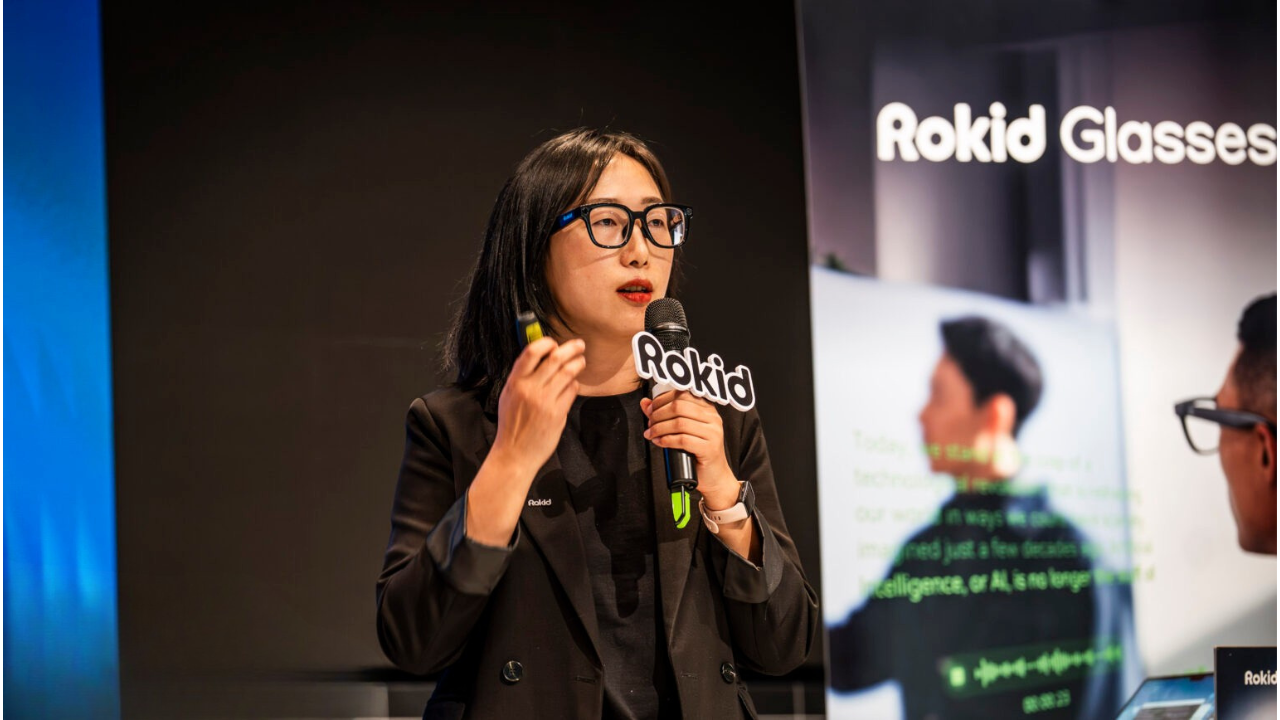
From Sino-French diplomacy to the frontlines of embedded artificial intelligence, Yuanfang “Irene” Long (MBA ’24) is now helping drive the global expansion of Rokid, the Chinese pioneer in smart glasses. Between Hangzhou, Paris and Munich, she deciphers the cultural and technological gaps between China and Europe while contributing to the rise of what she believes will become a new everyday digital interface: AI-powered glasses. Meet an HEC alumna who has become one of the faces of a technological revolution that remains largely unknown in Europe.
Rokid: The Smart Glasses Pioneer Europe Is Only Just Discovering
In Hangzhou, Rokid did not wait for smart glasses to become trendy before developing them. For more than eleven years, the Chinese company has been designing, testing and refining its technologies — long before the recent boom driven by generative AI and American tech giants. Since the early days of Google Glass, Rokid has pursued the same ambition: not to become the most visible brand, but to build the most advanced technology on the market.
The company launched its latest AI glasses in China at the end of 2024 before orchestrating, a few months later, its global rollout. In August 2025, Rokid entered the U.S. market with a Times Square campaign and coverage on Bloomberg TV, TechCrunch, and several specialized media outlets. The operation was led by Yuanfang “Irene” Long herself, who now oversees the European and American markets. Since then, more than 300,000 pairs have been sold across over 100 countries. Europe now represents the company’s next strategic frontier, with Germany serving as its first target market.
But the product goes far beyond being a simple tech gadget. The glasses offer real-time translation in 89 languages, subtitles displayed directly in the lenses during conversations, a teleprompter synchronized with the user’s speaking pace, automatic meeting summaries, hands-free navigation, and first-person video capture features. For people with hearing impairments, they can display conversations live in real time. For visually impaired users, they describe the surrounding environment out loud and detect certain obstacles. At Rokid, the motto “Leave nobody behind” is not just a marketing slogan — it is a core part of the company’s product vision.
Industrial applications are also expanding rapidly. In the petrochemical industry, some technicians already use the glasses to receive real-time remote assistance from experts without language barriers. In the automotive sector, they are used for inspection and assembly operations. Retail companies are currently exploring in-store navigation systems capable of guiding customers directly to the products they are looking for through the connected lenses. SAP recently approached the company to explore several enterprise use cases. Rokid is currently in its pre-IPO phase; financial data remains confidential, but commercial discussions are accelerating at high speed.
“Think about it: we use our eyes for more than fourteen hours a day. Glasses are probably the most natural interface there is.”

HEC as a Turning Point
Nothing initially destined Irene Long for a career in deeptech. Before HEC, she spent nearly eight years working in Sino-French diplomacy and economic relations. Government exchange programs, cooperation between sister cities, supporting French brands entering the Chinese market — her background was built far more around international relations than technology.
Fluent in French, she joined the HEC Paris MBA in 2022 with the idea of “taking a break to explore.” Then came ChatGPT. Like many people, she tried the tool. But unlike most users, she immediately saw it as a historic turning point. “I immediately felt: this is where I want to go,” she explains.
She then joined the HEC Alumni Digital Hub and began organizing her first events focused on artificial intelligence. This new environment acted as an accelerator. Without a technical background, she learned to navigate the tech ecosystem through her ability to connect people, cultures, and ideas. Her mentor Li Pei, an EMBA alumna, as well as Mona Audi-Montaldier, President of the Digital Hub, played a key role in this transition.
Back in China at the end of 2024, Irene decided to methodically analyze the local deeptech ecosystem. She organized a tour of seven of the country’s most promising startups, spanning humanoid robotics, neural interfaces, large language models, and smart glasses. Her conclusion came quickly: smart glasses were one of the few sectors already ready for mass global adoption. The technology works, the use cases already exist, but companies still lack profiles capable of bridging the gap between the Chinese and European markets.
At the same time, she launched the Chinese chapter of the HEC Alumni Digital Hub with an event bringing together several major players in Chinese AI and HEC alumni. Since then, she has regularly contributed to the network’s Paris-based initiatives by inviting representatives from the Chinese tech ecosystem to speak remotely. She is also involved in developing a partnership between HEC Paris and Zhejiang University, one of China’s most prestigious technological institutions.
Understanding the Gap Between China and Europe
Irene Long’s competitive advantage lies precisely in this dual cultural and strategic perspective. She clearly observes the difficulties some Chinese companies encounter when entering the European market.
The first gap is pace. “In China, when a technology gains momentum, the entire ecosystem accelerates immediately: investors, companies, partners, consumers. In Europe, the cycles are slower. You need to build trust before closing deals.” Many Chinese companies underestimate this difference in timing and later interpret their difficulties as market rejection rather than an issue with their approach.
The second challenge is brand communication. According to her, Chinese companies often excel at product execution and rapid innovation, but still underinvest in local storytelling and cultural adaptation. “You cannot communicate the same way in China and in Europe. You need to understand the references, the expectations, and even the fears.”
Her analysis is just as direct when it comes to innovation. China moves quickly because the entire ecosystem — government, companies, and the general public — is more willing to embrace technological experimentation. “In Europe, people sometimes ask questions about data protection before they have even tried the product. In China, people test first.”
The Next “iPhone Moment”?
For Irene Long, smart glasses will eventually become a new central interface in everyday life. Not immediately, she nuances, but gradually.
Today, the glasses still rely heavily on smartphones for part of their data processing. But upcoming technological advances could change that: embedded computing, integrated SIM cards, and new materials capable of automatically adapting the lenses to the user’s eyesight.
Within five years, she imagines people booking taxis, making payments, working, shopping, or managing their schedules directly through a pair of connected glasses. In China, some of these use cases are already beginning to emerge. In her view, Europe will eventually follow.
What if the next major technological shift no longer sat in our hands — but directly before our eyes?

Published by Rinade Chalach