

HEC Energy Club: Behind the scenes of industrial decarbonization
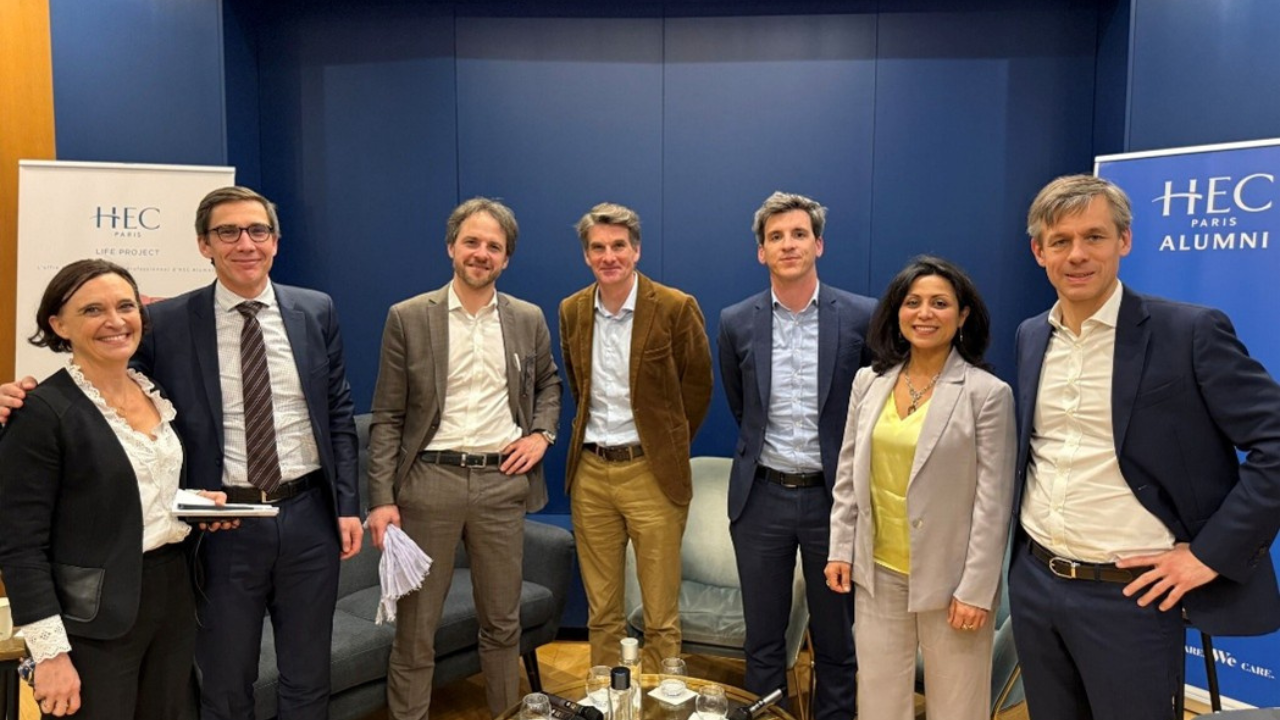
Long seen as a technical matter for engineers, energy has become a strategic battleground for executives—at the crossroads of costs, sovereignty, climate imperatives, and investor expectations. On March 25, by hosting the roundtable “Decarbonizing Industry: Constraints or Opportunities?”, the HEC Energy Club turned HEC Alumni into a true laboratory of climate thinking, where speakers from ADEME, Lafarge, Teréga, and TotalEnergies shared their decarbonization pathways with the alumni community.
This event is part of an already dense program led by the HEC Energy Club: innovation and energy, competitiveness of new energy sources, data centers, networks, and soon impact entrepreneurship and mobility. Under the leadership of Jérôme Bouquet and a committed team of alumni, the club has taken a clear stance: to treat energy no longer as a commodity, but as a systemic issue spanning geopolitics, defense, climate, and corporate strategy.
The format of the evening—moderated by Sarah Yarmohammadi and Juliette Barbarin—reflected this ambition. Bringing together a regulator, major corporations, and infrastructure operators, the roundtable aimed not only to inform but to confront complementary perspectives in front of current and future decision-makers, offering them concrete benchmarks on the industrial transformation underway.
A highly concentrated industrial transition
From the outset, David Marchal, Executive Director for Expertise and Programs at ADEME, set the macroeconomic scene. He noted that French industry currently emits around 80 Mt of CO₂ per year—already half the level of twenty years ago—but with strong geographic and sectoral concentration. As he put it, “most emissions come from nine major sectors, around fifty sites, and roughly fifteen industrial-port zones,” making it essential to clearly distinguish policies targeting “mega-sites” from those addressing the rest of the industrial fabric.
Marchal also emphasized that these trajectories are embedded in France’s National Low-Carbon Strategy (SNBC), which aims to divide emissions by six to eight by 2050. ADEME has co-developed sector-specific transition plans with industry players, combining the agency’s modeling capabilities, plant-level data, and demand and geopolitical scenarios. For the alumni present, the message was clear: the challenge is immense, but it is now mapped—and the credibility of corporate strategies will be judged by their alignment with these pathways.
Cement as a case study
To illustrate these constraints, Thomas de Charette, Head of Decarbonization, Strategy, and New Businesses at Lafarge, highlighted the ubiquity of his product: cement, the grey powder used to make concrete—the second most consumed material in the world after water. In France, he noted, all cement plants rank among the 50 most carbon-intensive industrial sites, placing the sector at the heart of decarbonization efforts.
He explained the sector’s specific challenge: “around 70% of emissions come from the decarbonation of limestone—i.e., the process itself—and only 30% from energy combustion.” In other words, even a complete shift in the energy mix is not enough. The industry must address the chemistry of the material, rethink cement formulations, increase recycling, and, as a last resort for unavoidable (“hard-to-abate”) emissions, rely on carbon capture and storage.
Referring to the EU’s Fit for 55 package—aiming to cut greenhouse gas emissions by at least 55% by 2030 and put the EU on track for climate neutrality by 2050—de Charette made it clear that incremental solutions will not suffice. For the HEC Energy Club, this testimony underscored a key idea: some industries cannot simply electrify without tackling deep physical constraints linked to raw materials. Decarbonization is therefore capital-intensive, long-term, and dependent on consistent public support and policy stability.
Infrastructures CO₂ et nouveaux modèles
Antoine Charbonnier, Head of the CO₂ Business Unit at Teréga and member of the HEC Energy Club board, began by outlining the company’s profile: a historic gas operator with 5,000 km of transmission network and 33 TWh of underground storage in southwest France. He explained how Teréga is repositioning itself within the transition—on one hand through “new gases” (biomethane, hydrogen), and on the other through CO₂ transport and storage.
In the Nouvelle-Aquitaine and Occitanie regions, around twenty major emitters account for nearly 6 Mt of CO₂ annually, part of which remains unavoidable even after energy optimization. The region’s subsurface offers an estimated 750 Mt of geological storage capacity, thanks to structures previously used for gas and oil.
Charbonnier described three carbon capture, transport, and storage projects currently under development—one in priority partnership with Lafarge—with investment decisions expected by the end of the decade and commissioning in the early 2030s. He stressed the importance of shared infrastructure models across multiple industrial players, as well as the regulatory and local acceptance challenges they entail.
This perspective frames decarbonization as an opportunity to build new, structuring infrastructure: CO₂ networks, storage hubs, and territorial logistics become new fields of activity, mobilizing financial, regulatory, and industrial expertise familiar to HEC graduates.
The role of carbon offsetting
Finally, Adrien Henry,Vice President of Nature-Based Solutions at TotalEnergies, addressed the issue of offsetting. He began with an order of magnitude: in 2015, TotalEnergies’ carbon footprint stood at around 446 Mt CO₂e, 90% of which fell under Scope 3—i.e., emissions from the use of its products by customers. He stressed that even a major player accounts for only a few percent of a global market, making decarbonization a collective effort rather than an isolated decision.
Henry outlined a three-pillar climate strategy: massive reallocation of investments toward electricity and renewables; reduction of direct emissions (Scopes 1 and 2); and only then, as a third step, the use of carbon offsetting through nature-based solutions. The goal is to dedicate the 2020s to “avoid” and “reduce,” while building a portfolio of projects capable, from 2030 onward, of gradually offsetting residual emissions through to 2050.
This makes clear that offsetting can only support an already robust decarbonization strategy—and that it requires rigorous governance, high-quality credits, enhanced transparency, and careful management of reputational risk.
Conclusion
Between the lines, the roundtable revealed three key elements about the positioning of the HEC Energy Club—and, more broadly, the alumni network. First, its ability to translate highly technical issues (cement chemistry, subsurface geology, carbon market architecture) into strategic decisions understandable to non-specialist executives. Second, its capacity to bring together regulators, large corporations, mid-sized companies, and alumni to debate pathways and credibility conditions.
Finally, the evening highlighted that the line between “constraint” and “opportunity” largely depends on how companies—often led or advised by alumni—respond to climate signals. By positioning itself as a place for rigorous analysis and informed debate, the HEC Energy Club is helping transform HEC Alumni from a career network into a collective actor in the industrial transition.
We extend our warm thanks to our four speakers—David Marchal, Thomas de Charette, Antoine Charbonnier, and Adrien Henry—who provided the HEC Alumni audience with insights that were at once concrete, demanding, and inspiring on the challenges, constraints, and opportunities of industrial decarbonization.
___________________

Published by La rédaction