
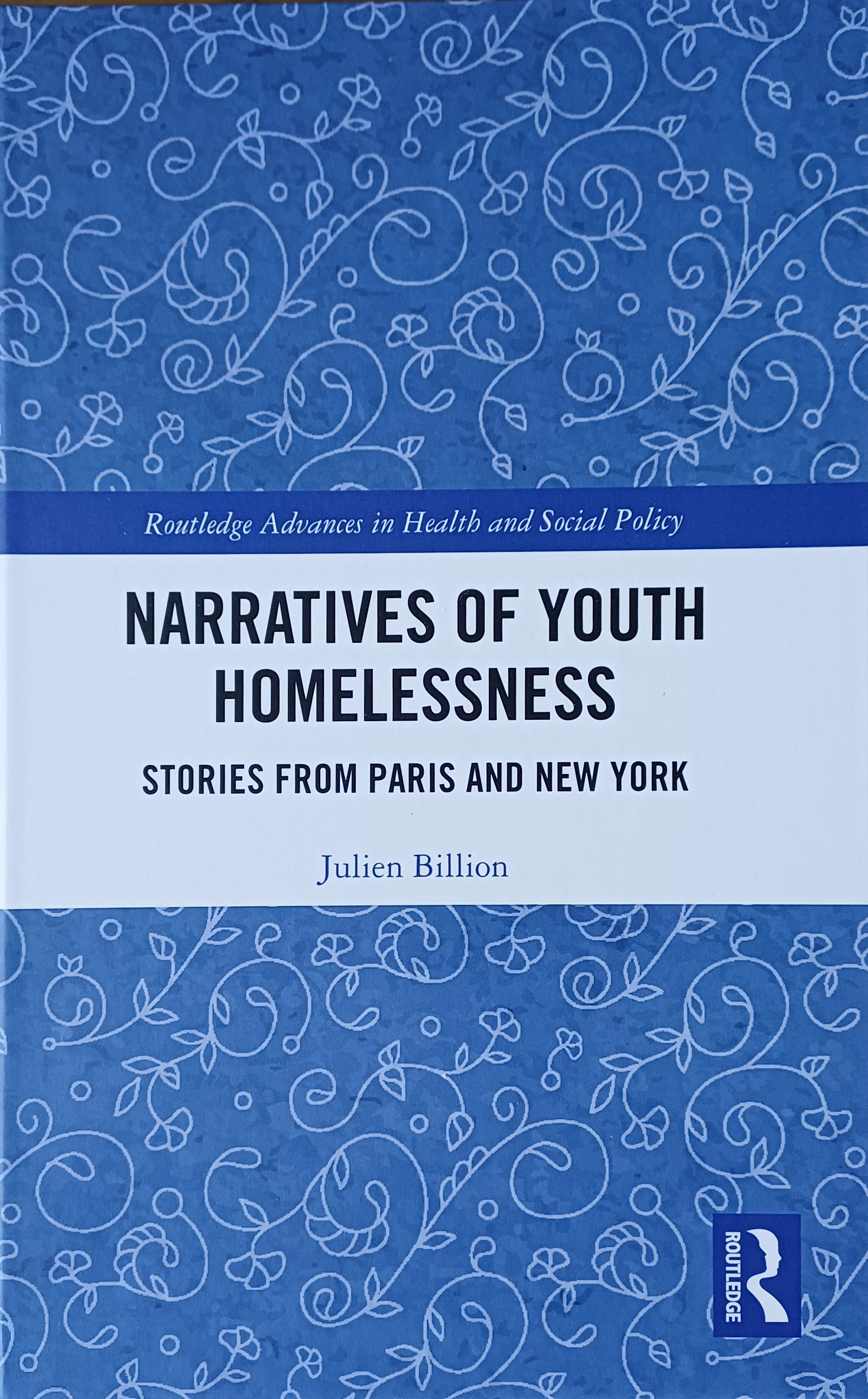
Julien Billion (E.17): four years alongside young people experiencing homelessness in Paris and NYC

Over the course of four years, as part of my doctoral research, I shared the daily lives of twenty young people in Paris and New York, accompanying them through streets, train stations, parks, support organizations, and emergency shelters.
Understanding the realities of young people experiencing homelessness could not be reduced to the analysis of data or public policies alone. I therefore chose an anthropological approach based on long-term field immersion. This research profoundly reshaped my understanding of social exclusion and ultimately led to the publication of my book, Narratives of Youth Homelessness: Stories from Paris and New York, recently published by Routledge.
The book features a foreword by Professor Kim Hopper, one of the world’s leading scholars on homelessness, and an afterword by Professor Robert E. Fullilove of Columbia University. Their support for this project represents a particularly meaningful academic recognition. Both emphasize the essential role of life stories in understanding the human experience of exclusion.
At the beginning, I thought I was going to study youth homelessness. Very quickly, however, I realized that the first step was to learn how to listen. As the conversations unfolded, I discovered that behind every trajectory was a unique story. Some had fled family violence. Others had experienced foster care breakdowns, addiction, discrimination, or conflicts related to their sexual orientation. No two lives were alike. Yet they all shared the same aspiration: to rebuild an ordinary life.
What struck me most was not only the hardship they faced. It was their remarkable ability to keep imagining a future despite everything. I remember a conversation with Professor Robert E. Fullilove, who asked me how I knew that genuine trust had developed with the young people I met. My answer came instinctively: “When they tell you their dreams.” When someone is willing to share their dreams, they are no longer telling you only about their past; they are entrusting you with part of their future.
This fieldwork also transformed the way I think about research. We often speak of scientific objectivity, but objectivity does not mean remaining detached. It means developing a sufficiently rigorous method to understand complex realities without oversimplifying them. In this project, that meant returning again and again, listening patiently, accepting silences, contradictions, and change. Human lives are never linear; they can only be understood by taking the time to accompany them.
Comparing Paris and New York was equally enlightening. Although the two cities have very different social systems, the mechanisms of exclusion—and the fundamental human needs that emerge from them—proved strikingly similar: to be recognized, to be able to trust others, to secure stable housing, and to gain access to education, employment, and supportive relationships. Beyond institutional differences, the life stories revealed deeply universal aspirations.
This book is also the culmination of a personal journey. Before becoming an academic, I worked as a social educator supporting vulnerable young people. That experience eventually led me to pursue a PhD jointly between EHESS and Columbia University. It continues to shape the way I conduct research today: beginning with people, listening to their stories, and connecting academic rigor with societal impact.
If there is one lesson I would take away from this experience, it is this: understanding the realities of young people experiencing homelessness requires multiple perspectives. Statistics help us measure the scale of the issue and inform public policy. Life stories, in turn, reveal the lived experiences behind the numbers. Both are essential.
I hope this book will, in its own modest way, help make these often-overlooked lives more visible and contribute to the work of researchers, practitioners, and policymakers committed to supporting young people experiencing homelessness. Research can certainly produce knowledge, but when it begins by listening, it can also transform the way we see social realities.
Julien Billion (E.17)

Published by La rédaction