
Gwendoline Finaz de Villaine: Stepping Into a Work of Art Like a Game?
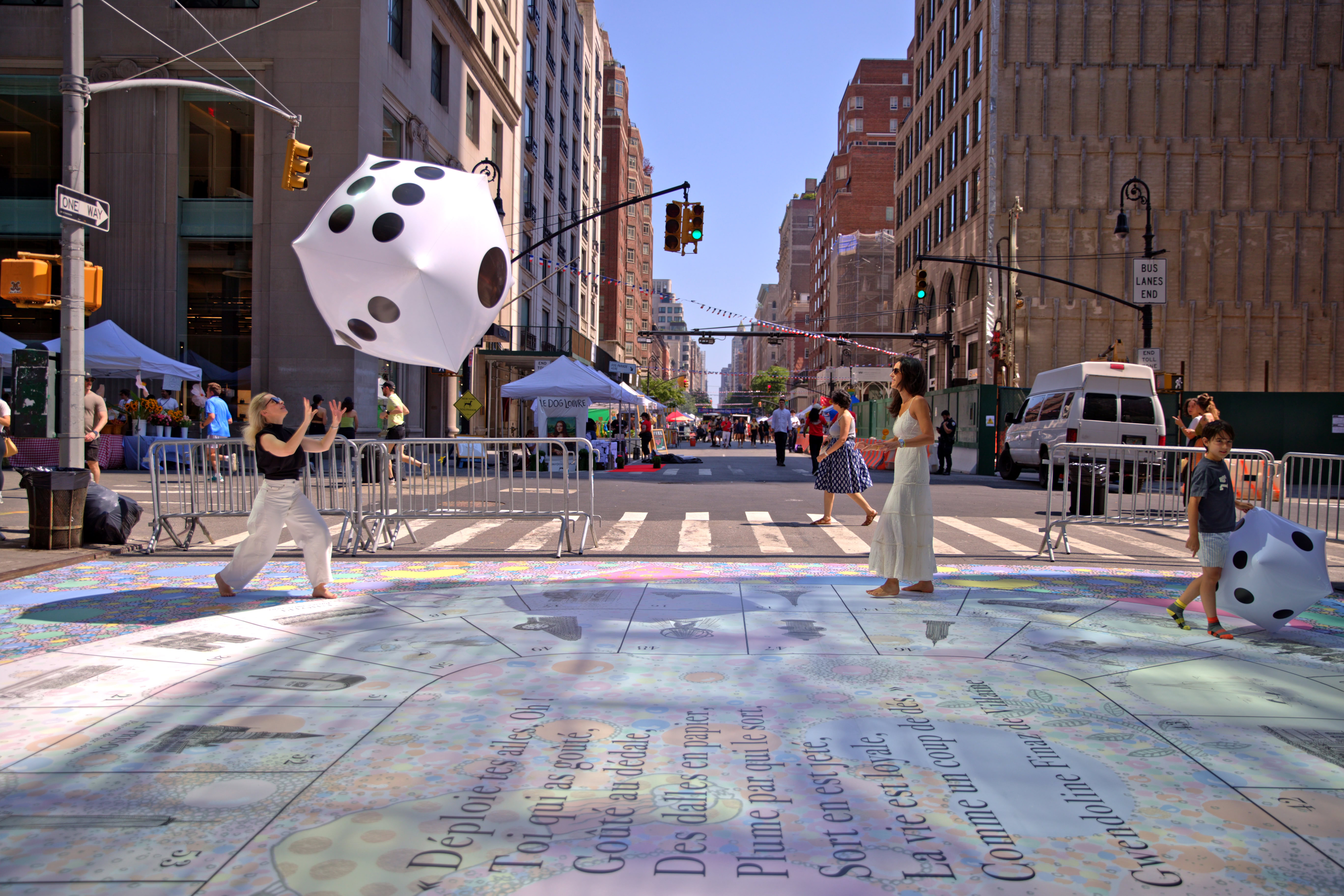
After three years in New York, Gwendoline Finaz de Villaine is back in Paris with an extraordinary project: a 200-square-meter monumental Game of the Goose, created with illustrator Pauline Lévêque. First presented on Madison Avenue last July, the artwork will take over the Parvis des Droits de l’Homme at the Trocadéro in Paris on September 19, as part of European Heritage Days and celebrations marking 250 years of Franco-American friendship. We met with an artist who turns painting into a collective experience.
Understanding Gwendoline Finaz de Villaine means accepting that she cannot be confined to a single box. A multidisciplinary artist, she studied at Sciences Po before joining HEC in 2000, then turned to her first passion: the stage. For around ten years, she devoted herself to musical theater, notably working alongside director Roger Louret, and performed in several productions, including Attention mesdames et messieurs with Michel Fugain at the Folies Bergère.
Writing then became an extension of this first artistic life, notably through her trilogy Les Brumes de Grandville. Over time, drawing and painting once again took center stage. She moved into the streets, created monumental murals and developed projects combining art, heritage and public space, including a mural dedicated to Joséphine Baker on the Place du Panthéon and two monumental dragons installed in Paris.
This trajectory may explain her taste for projects that go beyond the frame. “The galleries are closed, but street art is open!” she said when she first turned to street art during lockdown. Since then, she has continued to seek out new territories for her painting. Her three years in New York provided a new playground. And it was precisely there that her latest project was born: transforming a childhood game into a monumental work of art.
Two Years to Take Painting Beyond the Frame
In recent years, New York has been her testing ground. Gwendoline set up her studio there, exhibited her work and forged numerous connections. Her stay ended this summer with the first presentation of the Monumental Game of the Goose on Madison Avenue, as part of L’Alliance New York’s Bastille Day.
“I really used Alphabet Studio as an accelerator,” she explains. Her experience in New York proved to be a laboratory of sorts: “I didn’t think there would be any interest from the American media when I’m not known at all,” she says, with characteristic humility.
The project was born around two years ago, following a meeting with illustrator Pauline Lévêque, a French artist also based in New York. “She said to me, ‘I dream of doing something monumental.’” The two artists then began imagining a work that would bring their respective worlds together: painting for one, illustration for the other.
Very quickly, the idea of a simple monumental painting gave way to that of a true playground. “I had the idea of creating a board-like work of art that would gradually become a collective experience — a Game of the Goose,” Gwendoline explains.
The choice of game was no coincidence. It draws on both intimate and collective memories: “The Game of the Goose is my Proustian madeleine; it’s connected to our childhood.” But behind this emotional dimension lies a deeper reflection on chance and new beginnings. “It’s a game based purely on luck, with the possibility of reinventing yourself. It’s a game of resilience.”
It ultimately took two years to turn this intuition into a finished work: around one year of artistic creation and research, followed by a second year devoted to permits, partners, funding and production.
63 Squares Between Paris and New York
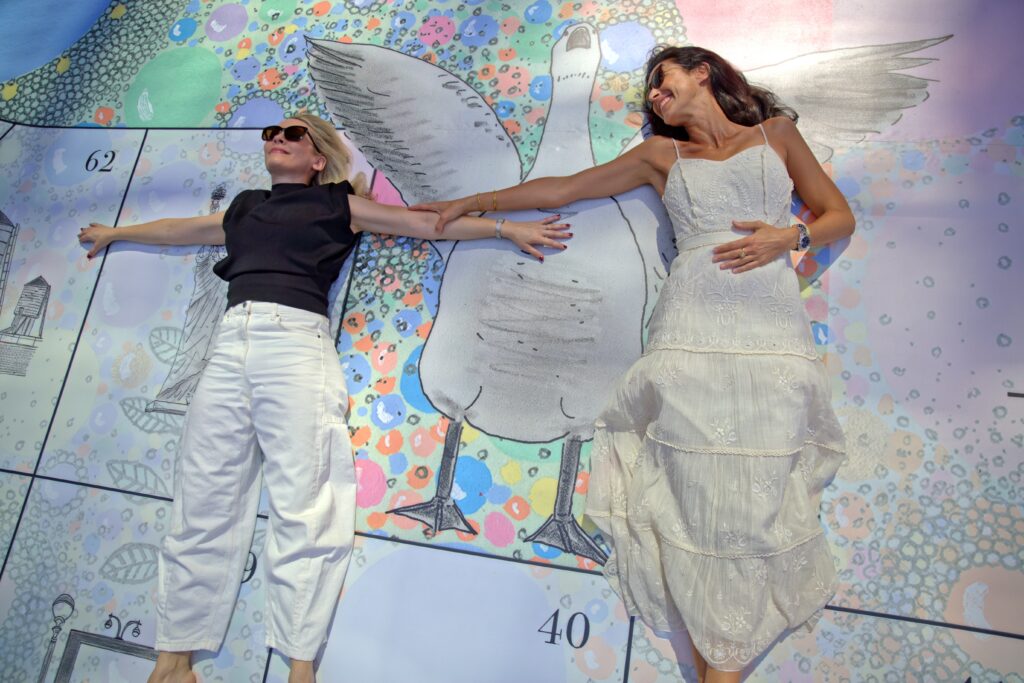
The result matches the ambition: a 15-by-10-meter canvas that visitors, young and old, are invited to step onto, becoming the pieces themselves. With its 63 squares, the work follows the traditional structure of the Game of the Goose while transforming it into an artistic journey between Paris and New York. The nearly 200-square-meter installation is designed to be explored and shared by the public. Gwendoline designed and painted the background, while Pauline Lévêque created the 63 illustrated squares. The journey begins at the gates of Versailles and ends at the Statue of Liberty.
“We really split the creation 50/50,” Gwendoline explains. “It was interesting to have this dialogue between two artistic worlds.”
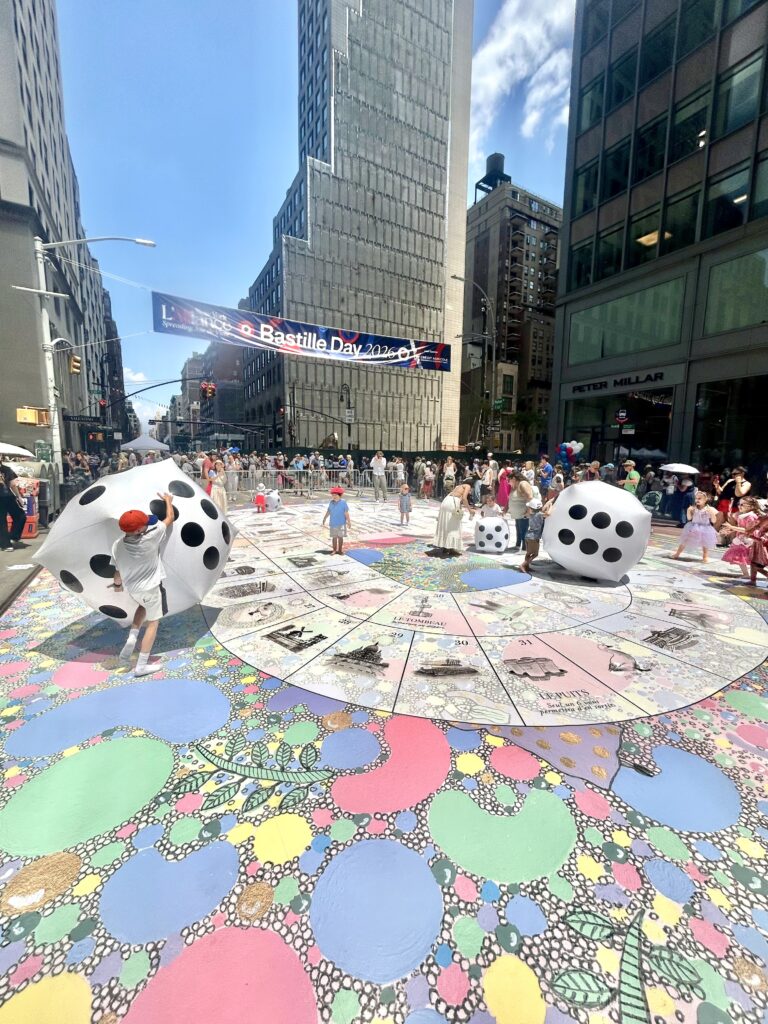
The 63 illustrations were then digitized and incorporated into the canvas one by one. But this work is not designed simply to be contemplated as a mural. The public inhabits it, using giant dice to move from square to square. For Gwendoline, this participatory dimension is essential: “The idea was to have an immersive game that people could step into, that would look like a theater stage while also being a giant game.”
A poem written by the artist, inspired in particular by the world of Jean Cocteau, marks the symbolic passage into the artwork. “It’s a bit like a portal. You enter a work of art. It’s not a playground activity: there’s a genuinely powerful experience to it.” The visitor moves from spectator to participant. “What interests me is transforming a painting into a collective human experience.”
From Madison Avenue to the Trocadéro: A Project Designed to Travel
The project’s first stop was New York, on Madison Avenue, during L’Alliance New York’s Bastille Day on July 14. For the two French artists, the location carried particular significance. The Game of the Goose became a link between two cities and two cultures, in a year celebrating 250 years of Franco-American friendship.
“This was originally supposed to take place in Versailles,” Gwendoline recalls. The project evolved through encounters and opportunities, before New York ultimately emerged as the destination.
Among the “good fairies in New York” who helped bring the project to life, Tatyana Franck, President of L’Alliance New York, played a decisive role by opening the doors of Bastille Day to the artists. “She was the number one person in New York who believed in us,” Gwendoline says gratefully.
The journey to Madison Avenue was not without its challenges. The canvas, produced in France, was held up in U.S. customs for ten days. Gwendoline recalls several sleepless nights spent filling out administrative documents: “Our credibility was on the line. It was terrible.” In the end, the canvas arrived just two days before the event and was subsequently brought back to France to be used again at the Trocadéro.
The first presentation also provided an opportunity to test the work at full scale. Gwendoline’s children acted as “crash-testers,” playing multiple rounds before the public presentation. Their feedback led to a few adjustments to the experience.
The 15-by-10-meter artwork also requires careful organization. In New York, the experience required substantial supervision. In Paris, the installation will likewise have a dedicated team and safety measures in place. Visitors will notably be asked to remove their shoes before stepping onto the canvas.
On September 19, the Monumental Game of the Goose will take over the Parvis des Droits de l’Homme, facing the Eiffel Tower, from 9 a.m. to 6 p.m. Presented as part of European Heritage Days, the installation will be free of charge.
The Cité de l’architecture et du patrimoine, a partner in the project, will help extend the experience: a QR code will provide access to the rules of the game in both French and English, as well as information about the monuments represented in the form of models.
And the artist is already thinking about what comes next. A limited-edition version could be created: “The idea would obviously be to also adapt the game into an art format — to create a real art game, in a limited, numbered series, and sell it.”
Other cities could also host the work. One possibility already being discussed with Paris je t’aime is a future version in Los Angeles.
Through this extraordinary Game of the Goose, Gwendoline Finaz de Villaine continues to pursue an approach that is uniquely hers: moving painting beyond its traditional boundaries, breaking down the barrier between the artwork and the person looking at it, and bringing art into spaces where it can meet its audience.

Published by Daphné Segretain