

Stéphane Richard: At Olympique de Marseille, Making Reason Prevail Without Losing the Passion
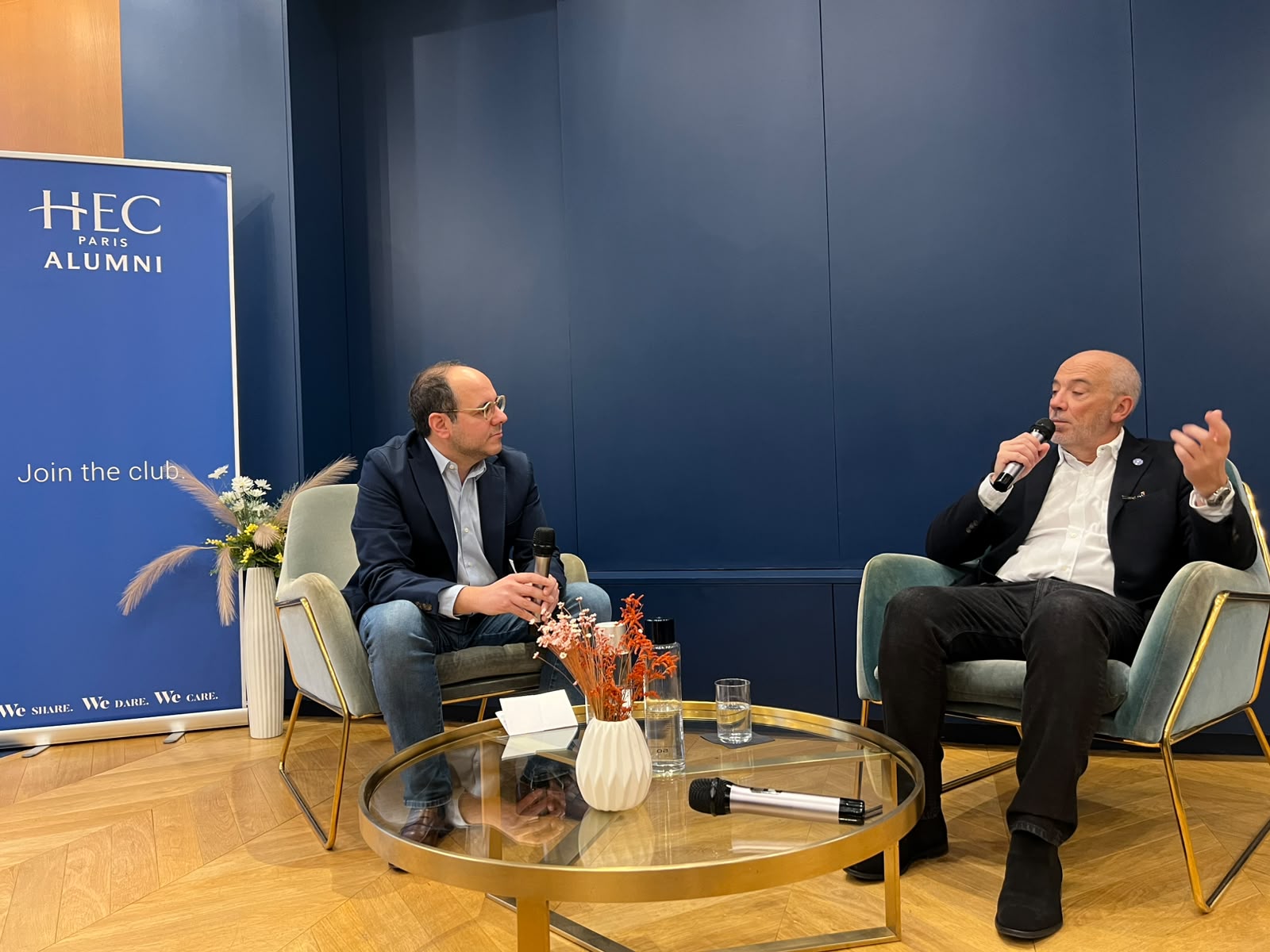
On November 12, HEC Alumni hosted a fully booked, exceptional breakfast event organized by its Sport Business Club. Welcomed by Mathieu Besson (EMBA.23), the Club’s coordinator, Stéphane Richard (H.83), Chairman of the Management Board of Olympique de Marseille (OM), was interviewed by Ghassan Attié (H.07), Co-Chair of the Sport Business Club. The agenda for this much-anticipated morning meeting included the inside story of his appointment at the helm of OM, the economic challenges facing French football, talent management, and the club’s ambitions for transformation. Drawing on his experience as CEO of Orange, the former corporate leader is determined to bring method, discipline, and strategic vision to an institution where passion knows few bounds.
Marseille: A Passion That Cannot Be Manufactured
Taking the helm of Olympique de Marseille is hardly like stepping into an ordinary business. When Frank McCourt approached him, Stéphane Richard found a club in turmoil: head coach Roberto De Zerbi, president Pablo Longoria, and sporting director had all departed. Three key figures leaving the ship at the same time. Just another crisis in OM’s turbulent history.
The American owner’s choice was an unusual one. He was looking for a leader from outside the world of football, someone capable of managing a complex organization, maintaining financial stability, and understanding its wider environment. Stéphane Richard’s profile stood out: a former senior civil servant who had worked at Veolia and, above all, served as Chairman and CEO of Orange for more than ten years. “We hit it off. He made me an offer the next day. I signed the contract three days later. It all happened pretty quickly,” he recalls, seated at 9 avenue Franklin Roosevelt at 8:15 a.m. that morning. A swift decision, almost in keeping with football itself, where crises rarely wait.
Marseille is familiar territory. It is the city he has made his home, one he describes with both affection and clear-eyed realism as “very endearing.” Because here, OM is much more than a football club. “Football in Marseille is a religion.” The Vélodrome regularly welcomes between 60,000 and 65,000 spectators, while local daily newspaper La Provence devotes several pages every day to OM news. “Thirty-five percent of La Provence readers buy the paper solely to read the OM pages,” the newspaper’s editor told Stéphane Richard.
Faced with such fervor, the new president intends to represent a change of approach. He has no intention of competing with the fans when it comes to passion. Instead, he champions method, composure, and the ability to take a step back. “When you are faced with an issue like this, which is a complex one, I believe it is important to approach it methodically and calmly, and to instill that same mindset in the people around you.”
His first decisions focused on rebuilding the club’s management and sporting structures. He persuaded Grégory Lorenzi, former sporting director of Brest, to join Marseille, then appointed Bruno Genesio as head coach. The choice was guided by a quality he considers fundamental: management skills. “A coach must be both a top-level technician and an outstanding manager.” In a dressing room made up of different personalities and cultures, the ability to bring people together matters just as much as designing a tactical system. A belief directly shaped by his experience as a senior executive: collective performance begins with the quality of individual management.
The Big Challenge: Rethinking the Economic Model
Behind the popular fervor, Stéphane Richard sees a major weakness: the French football business model is unsustainable. In his view, the main culprit is the crisis in broadcasting rights, which has created a considerable gap between French football and Europe’s leading leagues. He illustrates this widening divide with a striking comparison: “Hull City is at 120. We’re at 15.” The smallest club in the Premier League would therefore receive €120 million a year in broadcasting revenue, compared with €15 million for OM. A staggering difference that puts French clubs at a structural disadvantage.
The former Orange CEO knows the issue well. The telecom operator had itself ventured into sports broadcasting with Orange Sport. The experience proved particularly costly: “We were paying €200 million for rights, losing €200 million a year, to put it simply. So we lost €1 billion over the entire period.” That experience taught him just how difficult it is to build a viable business model around football in France.
For OM, three levers should help restore financial balance: direct revenues (ticketing, hospitality, sponsorship, and merchandising), income from European competitions, and player trading—that is, increasing players’ value and selling them on.
In the first area, Marseille already has significant strengths. Its popular appeal and commercial reach place it among the leading French clubs in terms of merchandising. But room for growth is limited: the Vélodrome is already close to full capacity, and the club’s supporter base is enormous.
Developing the academy has therefore become a strategic priority. “We need a major training center. We need an academy to bring in more young players, both for the first team and to contribute to the club’s economic model.” This infrastructure project is one of his key objectives. The equation is clear: develop players capable of joining the first team while also creating value in the transfer market.
Stéphane Richard draws a distinction between two models. The first involves spending heavily to recruit top players, in the hope that sporting success and European revenues will offset the costs. The second relies on more disciplined management, controlled spending, and long-term investment in youth development.
He readily cites Bayern Munich, which has managed to combine titles with financial discipline, notably thanks to its academy. He also praises the work carried out by PSG in identifying and supporting young talent. In his view, sporting success can no longer be considered separately from economic performance.
Management and Innovation: Building for the Long Term
Making OM financially stronger is only part of his mission. The executive also wants to establish a new management and operating culture. Asked how long he intends to remain involved, he points out that at 65, he is not planning for another twenty or twenty-five years. But his objectives are clearly defined.
The first is to turn the club’s finances around. OM recorded a loss of around €100 million last season, while failure to qualify for the Champions League deprives the organization of significant European revenues. Nevertheless, he does not consider financial balance unattainable. Regular qualification for European competitions, better cost control, and a few successful transfer deals could gradually change the picture.
The second objective is to get the new training center project firmly underway. The third, perhaps the most symbolic, is to change the club’s image. “I would like to have shown that football in Marseille can be about more than crises and clashes […] I would like to embody a different story, one of success.”
Alongside this ambition for transformation, he has another goal for the current season: the French Cup. Stéphane Richard makes no secret of his desire to see OM lift the trophy, which he believes holds particular significance for the supporters. Aware that the league remains a difficult challenge in the face of PSG, and that European silverware is still some way off, he believes his team has what it takes to compete for this trophy, provided they enjoy a favorable draw and avoid any slip-ups along the way. “If we can bring the French Cup back to the Vieux-Port, then just you wait,” he says. Such a prospect could offer the club and its supporters a long-awaited moment of shared celebration.
This ambition also requires a carefully considered communications strategy. Stéphane Richard favors speaking sparingly, reserving public statements for moments when they are genuinely needed. No running commentary on results or controversies: “I will speak out when I genuinely believe it is necessary.” A restrained approach that contrasts with the usual bustle of the Marseille football environment.
Another area he pays particular attention to is innovation. His experience at Orange made him keenly aware of the contribution technology can make to performance. Real-time player monitoring, physical performance data, match analysis, injury prevention, and health: digital tools now play an essential role in professional football. He has therefore decided to establish an innovation department reporting directly to the president. “I am convinced there is value to be found here, both in supporting the sporting project and in strengthening the business.” Sportstech, at the crossroads of sport, health, and well-being, is a particularly promising sector in his eyes.
Here again, his perspective is that of a business leader: football must become more professional, embrace new areas of expertise, and fully integrate technological change. The pitch alone is no longer enough to deliver performance.
“Football Needs HEC”
As the discussion unfolds, one conviction becomes increasingly clear: football has become a fully fledged industry, one that requires skills extending far beyond the sporting world itself. Asked about managing an organization considerably smaller than Orange, Stéphane Richard replies that the fundamentals remain the same. Bringing people together, motivating them, sharing a vision, and getting teams to work collectively: whatever the size of the company, the human factors remain essential.
Because OM is also a business, with employees, financial imperatives, and organizational challenges. A dimension sometimes overshadowed by the spotlight on the players and the passion in the stands.
As the meeting drew to a close, the HEC alumnus expressed his attachment to the school, recalling the student cohorts he had had the opportunity to welcome on campus and the lasting connection he maintains with his alma mater. Above all, he had a very direct message for students and graduates: “Sport and football need talent, including talent in business management, strategic vision, and innovation. Football needs engineers, and football needs HEC.”
A statement that resonates particularly strongly with the HEC Alumni community. The sports sector, he explains, offers tremendous opportunities for the future, at the intersection of economic, technological, and societal challenges. It touches on health, well-being, and longevity, while retaining one irreplaceable quality: collective emotion. “It will not be replaced by artificial intelligence, just like any other form of live entertainment. Football is live entertainment, but it also has a connection with people’s lives.”
In Marseille, Stéphane Richard intends to demonstrate that a club can be popular, ambitious, and financially responsible all at once. At the helm of an institution where emotion reigns supreme, his task is to reconcile the demands of the pitch with those of a complex organization operating in a rapidly changing economic and media environment. A management challenge in its own right, and one that illustrates what business schools can bring to the world of sport: strategic vision, financial discipline, and the ability to turn collective passion into a business project.

Published by Daphné Segretain