
Najwa Alam (H.26): a young afghan activist forced into exile
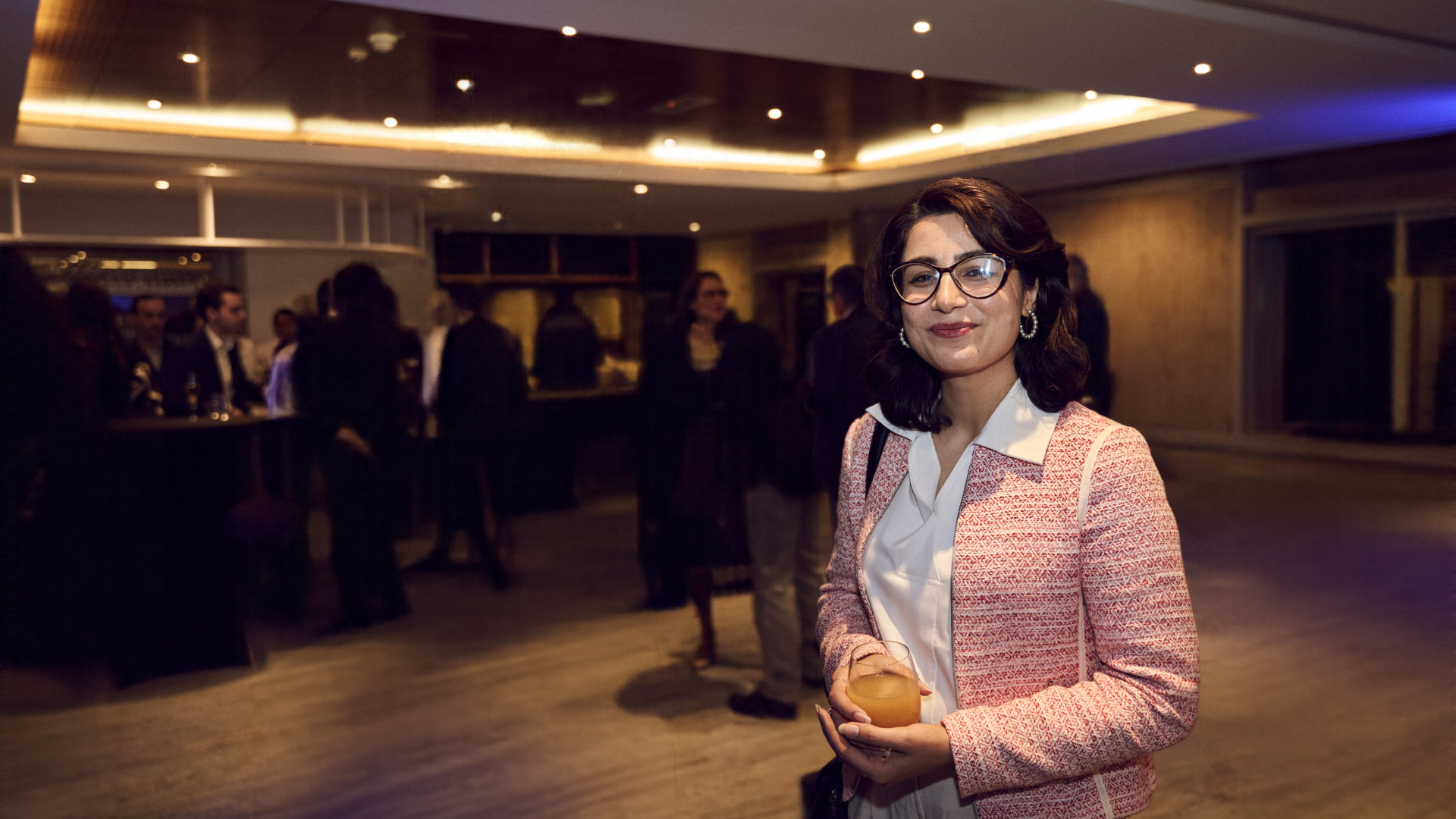
An advocate for girls’ education in Afghanistan from an early age, Najwa Alam (H.26) was forced to flee her country following the Taliban’s return to power. From Kabul to HEC Paris via Russia, this is the story of a young woman determined to turn her experiences and convictions into a force for change.
When Najwa Alam (H.26) looks back on her childhood in Kabul, her first memories are of family meals, birthdays and holidays. “For many people, Afghanistan is just what they see in the news. But for me, it’s so much more than that. It’s where my roots are, my identity, my culture.” She describes a country of mountains and rivers, rich in history, where hospitality is a deeply held value. A country she was forced to leave in 2022, following the Taliban’s return to power.
The eldest of three children, Najwa grew up in a family that placed great importance on education. Her father was an agricultural engineer and university professor, while her mother was a doctor. When she was nine or ten, a documentary about Bill Gates changed the course of her life. Her father explained how the American entrepreneur used his wealth to help those in need. “I told myself I wanted to be like him. To earn enough money to help others and make a difference.” In 2016, she decided to study computer science, a field still largely dominated by men in Afghanistan. She became the first female engineer in her family.
But it was also at school that her commitment to helping others first took shape. Several of her classmates, despite their academic potential, were forced to abandon their studies because of poverty or early marriage. “I used to wonder what they might have become if they’d been allowed to continue their education. Doctors, engineers, artists?” Watching her friends disappear from the classroom deeply affected her. At university, she began volunteering with an organisation defending women’s rights and girls’ education. Among other initiatives, she took part in meetings with fathers, encouraging them to allow their daughters to stay in school. “Some believed it was more worthwhile to invest in a boy’s education, because a girl was expected to get married. We tried to show them that an educated woman could be independent, contribute to her family’s income and take control of her own future.”
This commitment gradually led her into humanitarian work. After an internship at UNICEF, she worked on projects involving organisations including the World Food Programme and the World Bank. Initially specialising in data analysis, she became increasingly aware of the extent of gender inequality, including in the workplace. She subsequently moved into roles focusing on gender issues, working to improve women’s access to aid programmes and raise awareness among partner organisations. “There were inequalities at every level. Some women couldn’t even receive humanitarian aid because they didn’t have identity documents.”
Alongside her humanitarian work, Najwa also ventured into entrepreneurship. At just twenty, she developed a small business producing dried fruit, jams and preserves, using solar-powered drying equipment. The business grew rapidly: before the Covid-19 pandemic, it employed 25 women and four men. Her initiative even earned her an award recognising her achievements in production. The experience reinforced her belief that business can be a powerful driver of social change. “Starting a business isn’t just about making money. It’s also about giving other people the opportunity to work and build their own futures.”
A life upended by the taliban’s return to power
In August 2021, the Taliban’s return to power turned her life upside down. Restrictions on women multiplied: they were barred from education, from working in many sectors and from entering certain public spaces. “They weren’t just taking away the big things, like education or work. They were also depriving us of life’s small pleasures: having coffee with a friend, going to the park, wearing colourful clothes.” At first, Najwa refused to comply with these new rules. Alongside other activists, she took part in peaceful demonstrations defending girls’ right to education.
But the repression intensified. One day, several of her friends and fellow activists were arrested and imprisoned during a demonstration she herself had planned to attend. She learned that the authorities had information about her group and were trying to track down its members. Her family urged her to erase her social media presence and keep a low profile. She left the family home and went into hiding at her grandmother’s house for several weeks. “We still hoped that by protesting, by making our voices heard, we could change something. But the situation became dangerous.”
Leaving became a necessity, but escaping Afghanistan was far from straightforward. Opportunities to obtain visas were dwindling, while their cost was soaring. International scholarship programmes that many young Afghans had been counting on were suspended. “Afghanistan had become an open-air prison,” she recalls. Together with one of her brothers, Najwa improved her English and submitted numerous applications to continue her studies abroad. After being rejected for a scholarship in India, they were eventually both awarded scholarships to study in Russia.
In 2022, they left Kabul for St Petersburg. Their departure was almost miraculous: the day after Najwa obtained her visa, the Russian embassy in Kabul was hit by a bomb attack. Shortly after they left, direct flights were suspended. “Sometimes I wonder what would have happened if I’d been just one day or one week late. I probably wouldn’t be here today.”
At the celebration marking the fifth anniversary of the HEC Imagine Fellows programme, held at UNESCO House in Paris in September 2026.
Exile and a new beginning
Russia offered a refuge, but not yet the opportunity to build the future Najwa dreamed of. The country was itself at war with Ukraine, the cultural differences were considerable, and she saw few prospects for professional development. After nearly a year there, she continued searching for scholarships in Europe. In 2023, she was selected to join HEC Paris through the HEC Imagine Fellows programme, which enables students from conflict-affected countries to pursue their education.
Her arrival in France in October 2023 marked the beginning of a new chapter, though not without its challenges. She reached the Jouy-en-Josas campus several weeks late, right in the middle of the exam period. With an engineering background, she also had to adapt to a curriculum focused on business and management. “For the first few months, I did practically nothing but study. My mother kept asking whether I was really in France. She couldn’t understand why I hadn’t sent her any pictures of the Eiffel Tower!” She also discovered the French language and found some much-needed peace in walks around the campus after everything she had been through.
Her brother, who had remained in Russia, was awarded a scholarship to study in the United States in 2024. He now lives in California. Her parents and youngest brother are still in Kabul. Her mother, a doctor, is no longer able to practise medicine. For Najwa, who has refugee status in France, the separation is particularly painful. “During the holidays, I’d see other students going home to visit their families. I stayed on campus. I wished so much that I could do the same.”
Having graduated in 2026 with a specialisation in sustainability, Najwa now hopes to put her technological and entrepreneurial skills to work on projects that make a positive impact. She is particularly interested in climate-tech companies that combine innovation, business performance and environmental protection. Following an experience at Capgemini, she is now looking for a professional opportunity in France. “A business shouldn’t just be about making a profit. It can also help change the world.” An ambition that echoes the childhood dream inspired by Bill Gates.
Despite the hardships she has faced, Najwa has found something unexpected in France: a new family. Through a programme connecting international students with French families, she has built close relationships with people who support and look out for her. She particularly values this spirit of solidarity, which reflects the principles that have always guided her.
“I used to think home was a place, with walls and a roof. Now I know that home is really about people. People who listen to you, who care about you and who you can rely on.”
While she hopes one day to see her family again and return to a peaceful Afghanistan, Najwa is now determined to build her future in France. Without ever forgetting what forced her to leave, or the women back in her homeland who are still denied the freedom to choose their own destinies.

Published by Lionel Barcilon