
L’Heure H with Nicolas Dufourcq: France’s Debt Crisis, a Chronicle of Denial

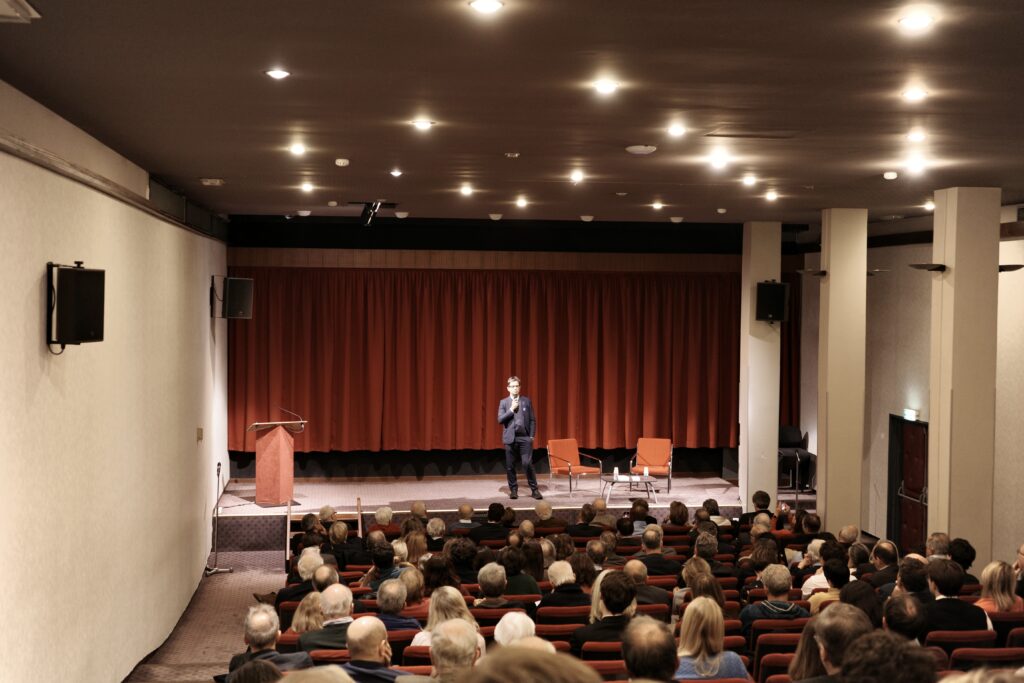
At Le Bon Conseil, in Paris’s 7th arrondissement, Nicolas Dufourcq, CEO of Bpifrance, was the guest of L’Heure H, the event series hosted by Michel Tardieu (H.66). Presenting his book La Dette sociale (Odile Jacob), he delivered an uncompromising assessment of France’s public finances. An ageing population, social commitments, political reluctance: behind the mounting deficits, he sees above all a country refusing to confront its own contradictions—and one that may ultimately have to pay the price.
He arrived with the somewhat unpredictable punctuality of SNCF trains, after a four-hour journey from Limoges. “Limoges—that’s still the old SNCF,” Nicolas Dufourcq remarked with the irony of someone accustomed to travelling extensively. He had come from the capital of the Limousin region following a stop on the French Fab roadshow, which takes middle- and high-school students on tours of industrial plants. The initiative, he explained, aims to “rekindle the flame of industry” and remind people that, in his view, France has managed to halt its deindustrialisation.
But that evening, in Paris’s 7th arrondissement, a different issue had brought him before the alumni and regular attendees of L’Heure H: debt. His latest book, La Dette sociale, grew out of a realisation that took shape over his years at the helm of Bpifrance. Financing entrepreneurs, supporting industry and stimulating growth are not enough if social spending continues to rise faster than the economy. Ultimately, such efforts are bound to prove futile. “If we cannot find a way to rein in the welfare state, we will fail,” he warned.
Two Horses Pulling the Same Cart
To explain his reasoning, Nicolas Dufourcq uses a simple image: “The state’s cart is pulled by two horses—or two oxen, whichever animal you prefer. One represents the economy, the other social spending. If one moves much faster than the other, the cart ends up in the ditch.” His entire argument revolves around the need to restore this balance. The French economy cannot sustainably finance public spending that grows at a pace so far removed from its own growth rate.
The turning point came around three years ago. Dufourcq was observing the efforts Bpifrance was making to support businesses and strengthen France’s productive base. But he also saw public spending, particularly social expenditure, rising again. With economic growth hovering around 1.5%, it was impossible to keep pace with spending increases of 3% to 4% a year. “We’ll never make it work,” he eventually concluded.
To understand what was driving this dynamic, he conducted an investigation and interviewed around fifty people. He initially expected to find much of the explanation in the growing number of civil servants or the proliferation of administrative structures. Instead, he reached a different conclusion: according to his calculations, around 59% of France’s debt is linked to current social benefits. The figure varies slightly depending on the calculation method, he acknowledges, but he considers the overall order of magnitude undeniable.
In his view, the underlying cause is demographic. France has failed to fully grasp what he calls the “longevity revolution”. Longer lives in good health are a major collective achievement, made possible in particular by medical progress and the welfare state. But this success comes at a cost. The additional years people live beyond the age of 65 weigh heavily on pension and healthcare expenditure, particularly as chronic illnesses emerge, often between the ages of 72 and 75.
“We refused to see that all this would inevitably have consequences,” he argues. France’s social security system was built at a time when life expectancy and the population structure were very different. Its funding must now be adapted to this new reality—not to dismantle what has been achieved, but to prevent the cost from being systematically passed on to future generations.
The Price of Political Inaction
In his book, Nicolas Dufourcq traces the origins of the problem through several decades of political decisions. He identifies a turning point in the 1970s, under President Valéry Giscard d’Estaing. New benefits were introduced or increased: family allowances, support schemes for people with disabilities, minimum old-age pensions and unemployment benefits. These were advances he considers necessary, but their funding already relied partly on borrowing.
What followed, in his account, was a succession of reforms announced, postponed or watered down. Budgetary rules drawn up in the 1980s, followed by the Maastricht criteria, sought to bring deficits under control. Yet changes of government regularly came with new entitlements, while pension reform became an increasingly untouchable subject.
The year 1995 occupies a central place in his narrative. Alain Juppé attempted to reform the pension and health insurance systems. Social mobilisation and strikes eventually forced him to withdraw the plan. For Nicolas Dufourcq, this episode established a lasting political fear of tampering with the social contract. “That was the year when, for the next ten years, the fear of undertaking another reform took hold,” he says. Subsequent governments proceeded cautiously, while the cost of delay continued to mount.
He does not underestimate the difficulties involved in reform or the strength of the French public’s attachment to its social model. Nevertheless, he believes that caution has turned into a form of political surrender. By constantly postponing difficult decisions, France is depriving itself of room for manoeuvre and allowing debt to become an accepted feature of the landscape. The problem is not merely an accounting issue; it is also cultural and political. French society, he argues, has come to regard certain arrangements as untouchable, regardless of whether they can be financed.
He compares France’s trajectory with that of other European countries, which have accepted sometimes painful adjustments. Italy, in particular, undertook a major pension reform in 2011. Other countries have managed to stabilise, or even reduce, their debt levels. In his view, the difference comes down to the decisions they made and the sacrifices they were willing to accept: “The hardship they accepted, and that we refused to accept.”
It is an intentionally provocative interpretation. But it raises a fundamental question: how long can a country continue to finance its promises without ensuring that it has the means to honour them?
“Adults in the Room”
Nicolas Dufourcq is all the more concerned about France’s situation because financial markets are now keeping a close eye on the country’s budget trajectory. He does not believe France needs to find the €125 billion in savings sometimes mentioned in public debate immediately. But he insists that the country must present a credible plan and start taking action. “All it takes is a first step for interest rates to start coming down,” he argues.
That first step could involve several areas: pensions, health insurance, or the introduction of a golden rule preventing current expenditure from being financed through debt. What matters most, in his view, is demonstrating that France has acknowledged the problem and is capable of tackling it. He sums up the challenge in a memorable phrase: “The markets need to feel that there are finally adults in the room.”
The risk is not simply that interest rates will rise. It is also that France could face a sudden, externally imposed correction just when it has run out of room for manoeuvre. Dufourcq envisages a president forced to address the French people in an emergency to announce a series of particularly painful measures. It is precisely this scenario that he hopes to prevent by calling for collective awareness.
Yet the head of Bpifrance does not present himself as an opponent of social protection. “I love the welfare state,” he insists. He believes France’s system remains highly redistributive and has helped protect the population against poverty and life’s uncertainties. He highlights the importance of spending on disability support and minimum-income benefits. In his view, public debate too often conflates inequality, poverty and living standards, even though these concepts describe very different realities.
The aim, therefore, is not to dismantle the welfare state, but to make it sustainable. This distinction is central to his argument: solidarity is not the problem; its funding model is no longer keeping up. France must be able to continue protecting its most vulnerable citizens without jeopardising its capacity to invest, produce and prepare for the future.
Rediscovering a Taste for the Future
The question of funding is closely connected to competitiveness. Nicolas Dufourcq points out that France has substantial savings and businesses capable of innovation. He sees industry as a key driver of renewed growth and wealth creation, which in turn will make it possible to finance the social model. This is also central to Bpifrance’s mission, with a significant share of its portfolio devoted to industry.
But Dufourcq is concerned about a political climate that discourages entrepreneurs and investors. Tax debates, proposals for new levies and the prospect of prolonged instability are, in his view, fuelling distrust. Some of his clients are preparing to transfer their assets abroad, even if they do not necessarily intend to leave France. What worries them most, he says, is not always any particular measure, but rather the feeling that the country is incapable of reforming itself.
He is also cautious about the short-term economic outlook. France will have to weather several difficult years, he believes, and businesses focused on consumer spending could suffer from stagnant or even declining purchasing power. By contrast, industrial and export-oriented companies may prove more resilient by seeking growth opportunities beyond France’s borders.
Yet his message is not simply one of warning. He also calls for a renewed sense of collective confidence. France remains a wealthy country, with substantial assets, high levels of savings and considerable industrial strengths. But it must be willing to look honestly at its weaknesses and make the necessary choices.
Throughout the discussion, Nicolas Dufourcq returns to the same idea: reform cannot be the sole responsibility of governments. It requires a public debate less constrained by political posturing and a society willing to acknowledge that not everything can be financed indefinitely. He regrets that the political centre has failed to make this case, caught between two forms of radicalism that he considers paralysing.
As he leaves Le Bon Conseil, where he gave up his membership of the Scouts (Les Louveteaux) more than fifty years ago, Dufourcq leaves his audience with one final thought. France is not condemned to decline, but it must break free from its passivity. “We weren’t born for this. Enough is enough. You see, we have a right to joy.” A conclusion that stands in striking contrast to the gravity of his diagnosis. And a reminder that, for Nicolas Dufourcq, putting public finances back on track is not an end in itself: it is the condition for rediscovering a taste for the future.

Published by Daphné Segretain