
HEC Imagine Fellows celebrates five years at UNESCO
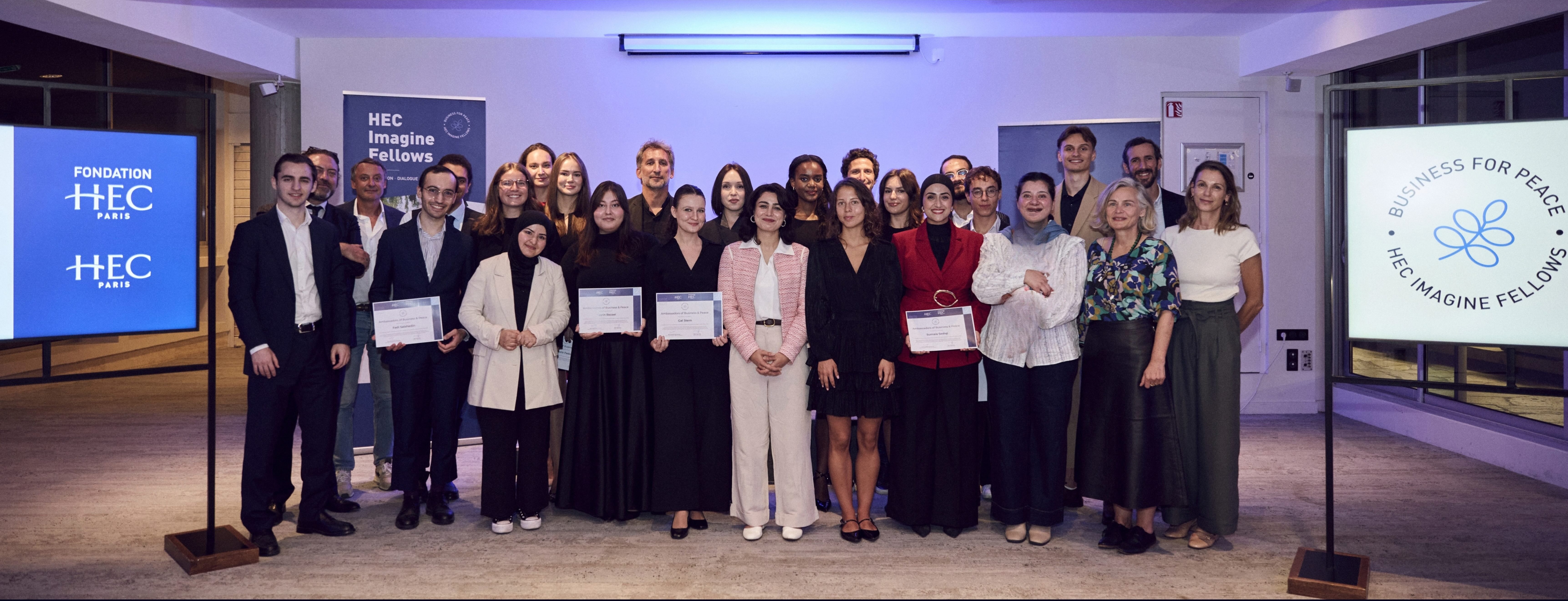
Since 2021, the HEC Imagine Fellows scholarship programme has helped young people from war-torn countries come to study at HEC Paris in Jouy-en-Josas. At UNESCO headquarters in Paris, Adrien Nussenbaum (H.01), the founder of HEC Imagine, joined the Dean of HEC Paris and leading diplomatic figures to celebrate the initiative’s fifth anniversary.
In Paris’s 7th arrondissement, UNESCO headquarters is a striking example of Brutalist concrete architecture. Nicknamed the “three-pointed star”, the building takes the shape of a “Y” when viewed from above. For more than half a century, the institution has carried out the United Nations’ mission in education, science and culture.
It was a fitting setting to celebrate an initiative dedicated to peace and education. Acting as masters of ceremonies, HEC lecturer Charles Autheman (M.09) and student Nikol Myroshnychenko (H.28) — whose profile appeared in HEC Stories in June 2026 — welcomed a distinguished line-up of speakers to the stage. Jean-Noël Barrot (H.07, PhD.13), France’s Minister for Europe and Foreign Affairs, Gaël Veyssière, former French Ambassador to Ukraine, and Nadiia Vatulova, Education Adviser at the Ukrainian Embassy in France, offered insights into today’s geopolitical challenges. Meanwhile, Éloïc Peyrache, Dean and CEO of HEC Paris, and Adrien Nussenbaum (H.01), founder of Mirakl and President of HEC Alumni, reflected on the origins and development of the HEC Imagine Fellows programme. Finally, Moralie Mihigo (X-HEC.27), a student from the Democratic Republic of the Congo, spoke about the situation in the Kivu region in the east of her country.
Taking action as international tensions rise
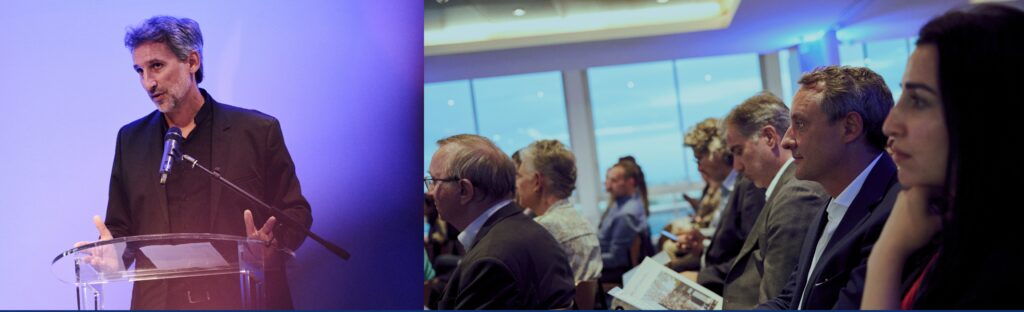
Opening the anniversary celebration, Éloïc Peyrache shared an anecdote about how Imagine Fellows first came about. It all began with a conversation with Adrien Nussenbaum about the extraordinary donation made by Blackstone founder Stephen Schwarzman to Tsinghua University in Beijing. Worth hundreds of millions of dollars, the gift funded the creation of Schwarzman College and a prestigious scholarship programme for international students, most of them American.“This was during Donald Trump’s first term in office. When the American philanthropist was asked why he had chosen to donate to Tsinghua University in China rather than Yale or Harvard in the United States, he replied: ‘As relations between the United States and China are bound to become more strained, my aim is to bring talented young people from around the world to study at Tsinghua for a year, alongside the future leaders of the Chinese Communist Party. My hope is that, when relations between the two countries really deteriorate, they will think to pick up the phone and call one another.’ I told Adrien Nussenbaum about this, and he said: ‘That’s brilliant. And I have a suggestion: let’s recruit our students from countries at war.’ That’s how the idea for HEC Imagine Fellows was born.”
Jean-Noël Barrot (H.07, PhD.13), who was lending his patronage to the event, was unable to attend due to other commitments. He had recorded a video address highlighting the powerful links between peace among nations, education for young people and economic exchange.
“With 65 state-involved conflicts, the world is experiencing its highest level of conflict since 1946,” he began. “In a world that is becoming increasingly brutal, peace can no longer be taken for granted: it must be prepared for and built. It begins in schools, in people’s minds, on campuses and in universities, but also in businesses. And it is through trade and economic interdependence, founded on shared interests, that the conditions for lasting and sustainable peace are created.”
The human stories behind the programme
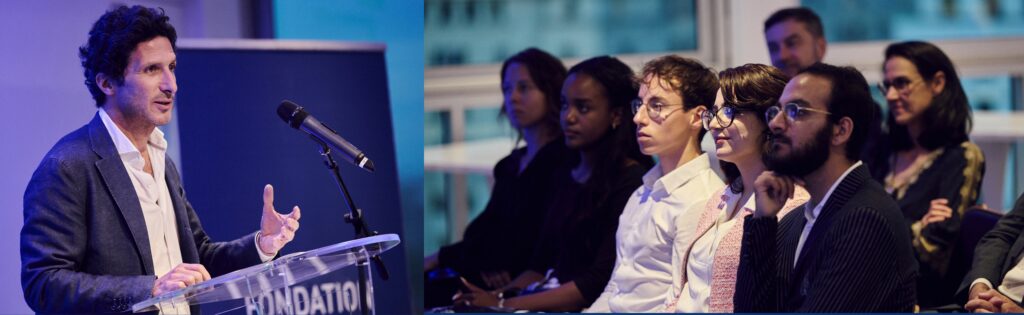
Speaking after the minister, Adrien Nussenbaum, who established the HEC Imagine Fellows scholarship with an initial donation of €1.1 million, reflected on how powerless individuals can feel in the face of injustice, war and arbitrary acts of oppression. “But there’s a saying I’m particularly fond of: ‘Whoever saves one life saves the entire world.’ Those words challenge that feeling of helplessness. They remind us that every life matters. And they tell us that we don’t have to change the whole world to begin making a difference.”
It is a conviction shared by HEC’s Dean, who pointed out that students of 130 different nationalities study side by side at the School.
“This diversity is an enormous asset for HEC and a major strength in building its international reputation. But beyond that, we would like these students to become ambassadors for diversity around the world.”
On campus, the Imagine Fellows students have given a human face to a generation of young people whose lives have been shaped by war. “Very quickly, this initiative became something tangible, embodied by the students themselves, their faces and their stories. For example, Behishta Nazir (H.24) is with us this evening. She was one of the programme’s pioneers — her profile appeared in HEC Stories in September 2024 — and is now a social impact entrepreneur in Germany and a young mother. When I think back to the first time we heard about Behishta, how she had escaped from Afghanistan and made her way to refugee camps, and how she eventually arrived on the HEC campus without speaking a word of French, I feel truly proud of what we have achieved together as a community,” Adrien Nussenbaum said.
Beyond transforming individual lives, HEC Imagine Fellows has also brought about change within the School itself. The programme has enabled these young people to continue their education and build a future for themselves. At the same time, their presence on campus has enriched the entire HEC community. “The students we have welcomed have taught us a great deal too,” Éloïc Peyrache emphasised. “We have introduced courses on Business and Human Rights. We have also developed and explored themes around Business for Peace. It has been a transformative experience for us.”
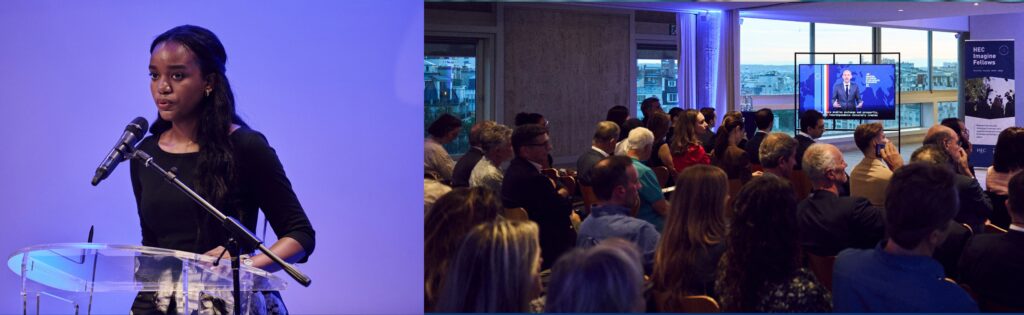
Illustrating this exchange of experiences and perspectives, Moralie Mihigo (X-HEC.27), from the Democratic Republic of the Congo, took to the stage to describe the tensions and violence affecting the Kivu region. Rich in minerals and rare earth elements, the region has become the focus of competing armed factions that oppress and attack local communities. What should have been a blessing for its inhabitants has instead become a curse. Subsequent speakers also highlighted the extraordinary resilience of the Ukrainian people, who have been resisting the Russian invasion for four and a half years.
At the close of the ceremony, the students were presented with Peace Ambassador diplomas before joining guests for an informal gathering in UNESCO’s reception rooms.
Five years after its creation, HEC Imagine Fellows has demonstrated that higher education has a role to play far beyond the transmission of knowledge. Adrien Nussenbaum summed up this ambition in a few words: “A school must ask itself what role it wants to play in society, beyond the education it provides. What better place than a school — where dreams and careers take shape, and where students from all over the world come together — to help build a better future?”

Published by Lionel Barcilon