
Frédéric Jousset: From Everest to Art Explora
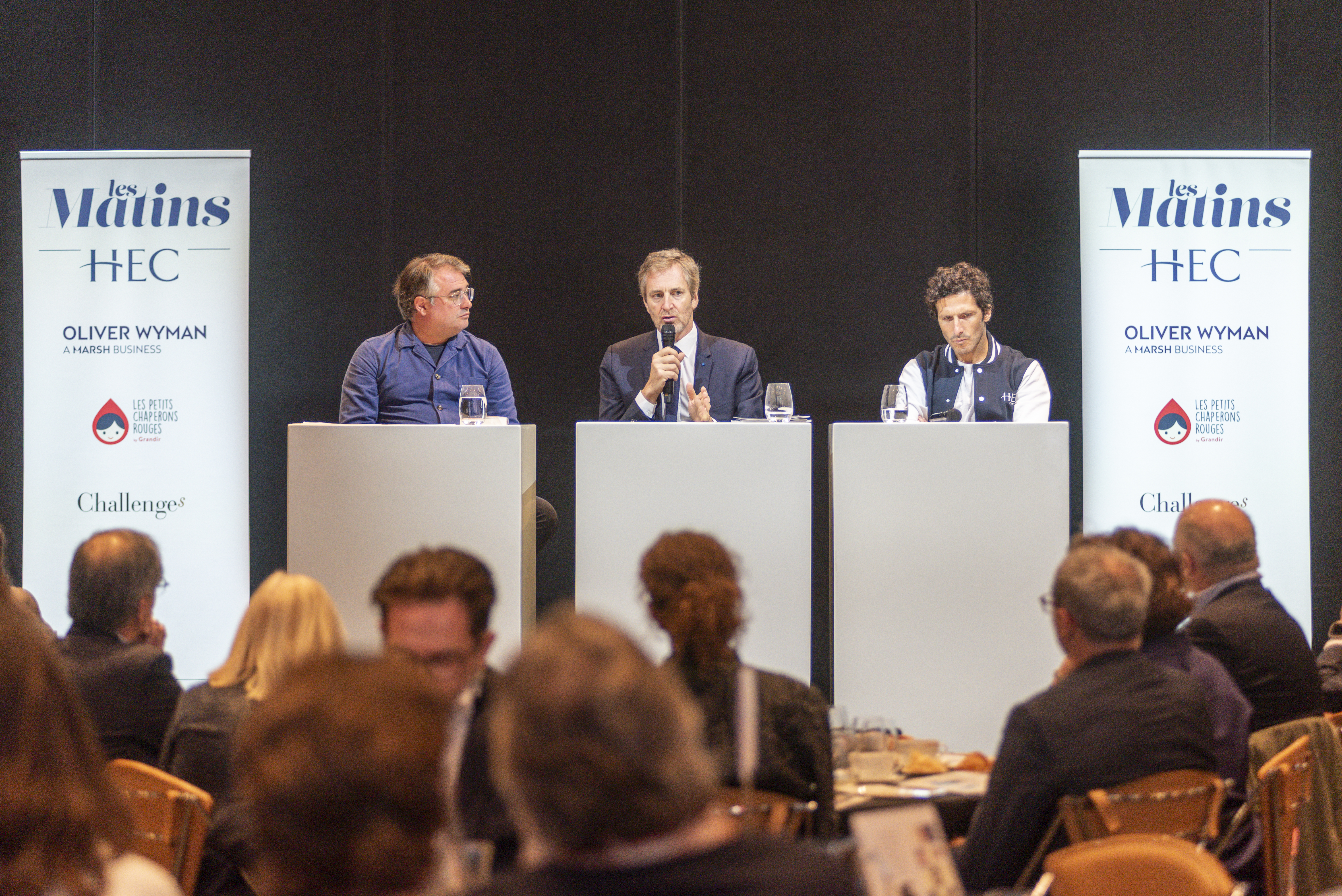
Guest speaker at the 350th Matin HEC on Thursday, October 8, to mark the publication of his book L’Eau, l’air et l’art (Water, Air and Art), Frédéric Jousset (H.92), co-founder of Webhelp and Chairman of Art Explora, answered questions from Emmanuel Duteil, Editor-in-Chief of Challenges, as well as questions from the audience.
“Entrepreneur, philanthropist, collector, adventurer, media executive and now author… How can so many lives fit into one?” asked Adrien Nussenbaum (H.01), President of HEC Alumni, as he introduced Frédéric Jousset alongside Hanna Moukanas, Partner at Oliver Wyman.
His entrepreneurial journey began in 1998 with the launch of Clientis, a software publisher offering a management solution for hair salons and beauty institutes. The venture ended in failure. Frédéric, who describes himself as “a man of second attempts” — joking that he needed two tries to pass his driving test, get into HEC and reach the summit of Mont Blanc, and that he has been married twice — drew three lessons from the experience: “Starting a business alone is extremely difficult. It’s better to have a partner with whom you can share your doubts and dreams. Second, it’s better to start with substantial resources than to rely on your personal savings. Third, avoid markets that are too niche.”
In June 2000, he raised €5 million and co-founded Webhelp with Olivier Duha. The company initially operated a human-assisted search engine for the web. A few months later, a formidable competitor entered the European market: Google. “I realised that we were selling candles while they were offering electricity.”
The company quickly pivoted, repositioning itself in online customer relationship management, where it became one of the world’s leading players. History repeated itself in late November 2022, with the launch of ChatGPT: Frédéric realised that Webhelp could not compete with AI. He arranged for the company to be put up for sale, leading to its acquisition by Concentrix for $4.8 billion. “I’m genuinely one of the few entrepreneurs whose business has been hit by a technological wave twice, twenty years apart.”
Yet even without this technological upheaval, he had been planning a change of direction. “Climbing Everest in 2019 was my road to Damascus. The experience was so intense, both in joy and in pain, that I could not have imagined going back to my former life.”
credit photo : Martin Barzilaï for Challenges magazine
He decided to devote himself to narrowing the cultural divide and built a virtuous ecosystem comprising Beaux-Arts Magazine Group, a leading European arts media group; Art Explora, a foundation recognised as being of public interest, whose mission is to bring art to people through mobile museums and a catamaran that travels around the Mediterranean; and ArtNova, an impact investment fund that channels more than 50% of its capital gains back to the foundation.
“Art Explora’s field of action is immense: the goal is to bring tens of millions of people closer to culture, which requires considerable resources. We rely on philanthropy and grants. I contribute half of the foundation’s annual budget of €18 million.”
The foundation is run like a business, with the same high standards and focus on performance. “Our goal is impact. But we are not turning our backs on the practices that have proved successful in the business world.” Art Explora’s team members are passionate about art, culture and sharing knowledge. They track how visitors engage with the foundation’s museums and programmes, just as companies monitor consumer behaviour and customer satisfaction online.
In his book L’Eau, l’air et l’art, published by Gallimard, all proceeds from which will go to Art Explora, Frédéric explains why culture and art are vital to human life. “Since the days of Lascaux, human beings have demonstrated their need for beauty, aesthetics and meaning.” During his six-week ascent of Everest, music helped him on his journey to the summit. “It doesn’t change your metabolism, but it carries you and transports you.” An encounter with a work of art can change the course of a life. He cites the example of Jean-Luc Martinez, the son of Spanish immigrants, who visited the Louvre’s Greek sculpture department at the age of twelve. The experience sparked his vocation as an archaeologist and art historian, eventually leading him to head the world’s most visited museum from 2013 to 2021. “We all have a work of art, a book or a film that has marked a decisive turning point in our lives.”
At a time when 50% of French people did not buy a book in 2025, 70% never attend a classical music concert and 80% never go to the opera, tens of thousands of children visited Art Explora’s mobile museum trucks last year.These mobile museums are made possible by loans from national institutions such as the Musée d’Orsay, which agree to take the risk of sending their works on the road to reach audiences across France. “Art Explora is a home for all forms of art and every historical period, from Renaissance paintings to hip-hop battles and film screenings. We seek to remove the barriers faced by audiences who are often distant from cultural institutions: distance, cost and lack of interest.”
Appreciating a Renaissance painting or a three-hour opera can be difficult without the necessary cultural references or some prior introduction. “Art is like wine tasting: you need to train your palate to appreciate it.” To compete for people’s attention, the mobile museums also ensure that visits last less than 30 minutes. Art Explora also runs an artist residency programme at the Cité internationale des arts, in Montmartre, Paris, and in Tirana, Albania. The foundation supports and accommodates around sixty artists in residence each year. “It’s harder than getting into HEC: we receive an average of 5,000 applications for around ten places.” Conceived as a collective endeavour from the outset, Art Explora is set to become a foundation that can host other philanthropic initiatives by the end of 2026. This will enable cultural associations that lack the appropriate structures to raise philanthropic funds to do so transparently.
Frédéric has publicly pledged to leave half of his wealth to the foundation. Philanthropy is a family tradition among the Joussets, initiated by his grandfather and continued by his father. He hopes to pass it on to his own two daughters, aged ten and three, who were the first readers he had in mind when writing his book.
“Philanthropy is not a billionaire’s sport,” he points out. “The HEC community, for example, includes thousands of volunteers who give their time to support and energise the alumni network. That is just as important as giving money. And financially, the amount doesn’t matter: what counts is the act of giving.”
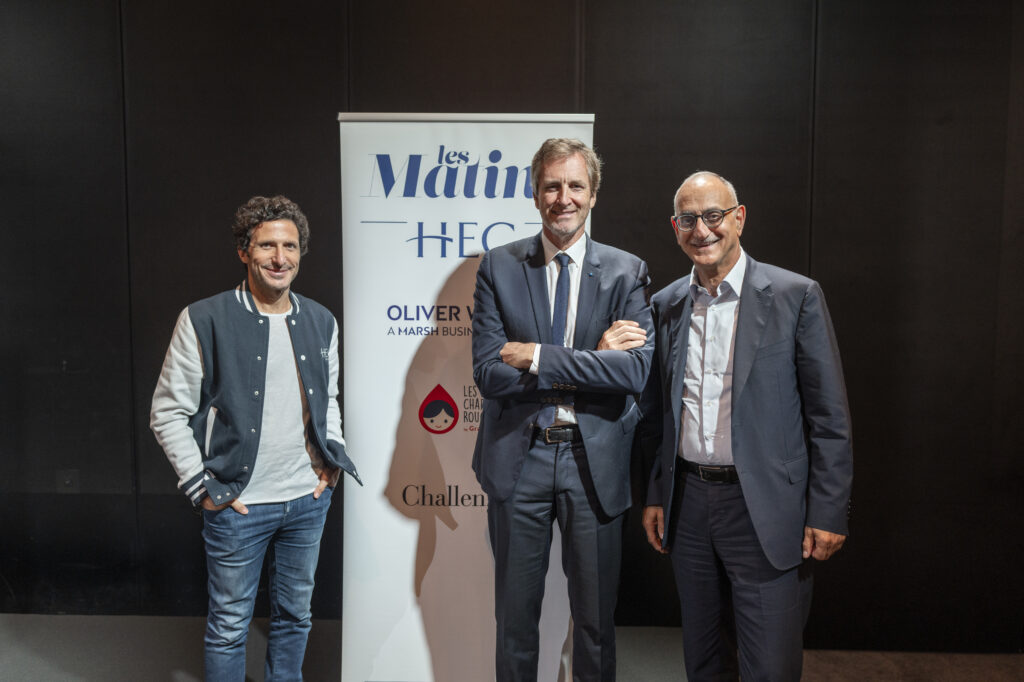
From left to right: Adrien Nussenbaum (H.01), President of HEC Alumni; Frédéric Jousset; and Hanna Moukanas, Partner and Chairman of Oliver Wyman France.
Les Matins HEC are organized in partnership with:


Published by Marianne Gérard