

Abdulrahman Al Jumaily: Learning to Lead Differently
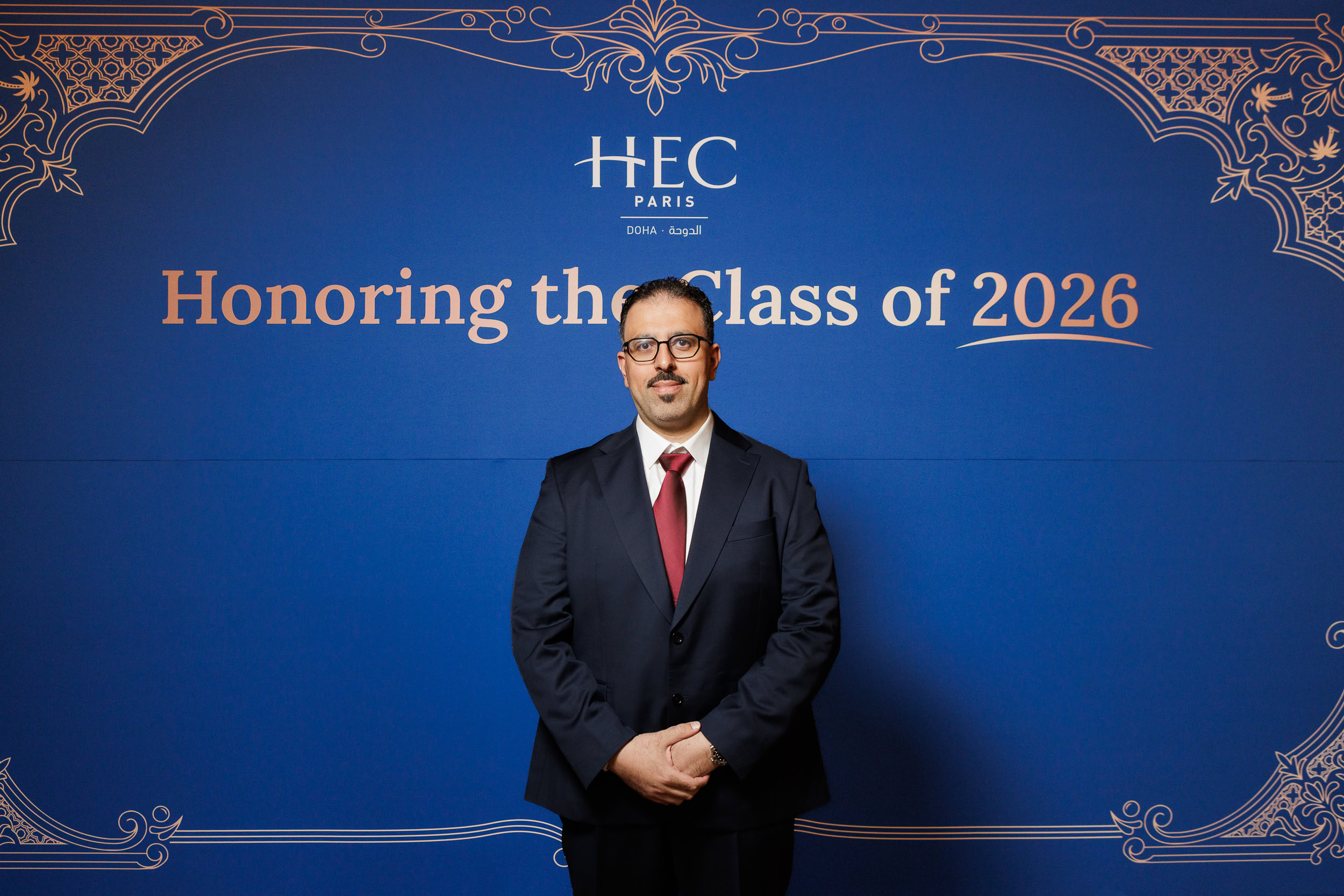
On the eve of the HEC Paris graduation ceremony, more than 144 graduates from across the Gulf Cooperation Council (GCC) countries, accompanied by their families, gathered in Paris for the fourth edition of the HEC Paris, Doha Graduation Reception. Held at Hôtel Le Marois, just steps away from the Champs-Élysées, the event celebrated the academic achievements, leadership journeys, and personal transformations that defined the Class of 2026.
Among the graduates was Abdulrahman Al Jumaily, Director of Financial Operations & Accounting at Qatar Foundation and Social Representative of the Executive MBA Doha cohort. Just a few days earlier, he had addressed his classmates, the HEC Paris, Doha team, alumni, and their families to reflect on what he considers the true value of the Executive MBA experience: the human connections built throughout the journey.
For the Qatari executive, earning the degree represents far more than an academic achievement. It marks the culmination of a transformative journey that profoundly changed the way he leads, makes decisions, and understands his impact within his organization.
From Finance to a Mission Driven by Impact
A graduate in Accounting from Qatar University, Abdulrahman Al Jumaily built his career in finance. After beginning his professional journey at Dolphin Energy, one of the Gulf region’s most significant energy projects, he joined Qatar Foundation, where he now serves as Director of Financial Operations & Accounting.
With nearly twenty years of experience, the finance specialist oversees the organization’s financial operations, financial reporting, and control mechanisms that ensure the responsible management of resources.
Yet working at Qatar Foundation requires a different perspective on performance.
Founded in 1995, the institution supports Qatar’s journey toward a diversified and sustainable economy through education, research, innovation, and community development. Today, its ecosystem of more than 50 entities advances areas including sustainability, artificial intelligence, precision healthcare, and social progress. Education City, its 12-square-kilometer flagship campus in Doha, brings together world-class educational institutions, research centers, and community facilities to foster lifelong learning, innovation, and positive societal impact in Qatar and beyond.
“We do not measure success through profitability,” the graduate explains. “We measure it through the impact we create for society.” This notion of impact gradually became one of the defining themes of his career.
When the Right Time Finally Arrives
The idea of pursuing an Executive MBA was not a recent one. On several occasions, Abdulrahman Al Jumaily considered returning to university. Yet each attempt coincided with a major career development that led him to postpone his plans. Twice, he decided against it after receiving a promotion. Then came the moment when he realized he could no longer wait. Fully aware of the personal commitment required by an Executive MBA, he joined HEC Paris, Doha with a clear understanding of the challenge ahead. Program leaders had warned him that he would need to balance career responsibilities, family life, and academic demands within one of the world’s most renowned Executive MBA programs. Yet he saw it as a unique opportunity to step outside his comfort zone and develop a broader perspective on leadership. “I wanted to elevate my skills and take them to another level,” he says.
Learning as Much from Peers as from Professors
The Executive MBA quickly brought an unexpected surprise. The academic content certainly met his expectations. However, what left the greatest impression was not necessarily what happened in the classroom or during case studies. It was the diversity of the cohort. Around him were executives from healthcare, government, law, technology, energy, and entrepreneurship, each bringing different experiences and perspectives. This diversity transformed discussions into genuine laboratories of ideas. For a finance professional accustomed to analyzing situations through a specific lens, discovering how other industries approached similar challenges proved particularly enriching. “I learned a tremendous amount from people working in healthcare, technology, and legal fields,” explains the class representative. “They learned from me, and I learned from them.” Throughout the program, every topic was examined from multiple perspectives. Financial decisions were no longer evaluated solely through their economic consequences, but also through their human, operational, strategic, and societal dimensions.
Beyond Numbers: Learning to Become a Leader
Among the lessons that had the greatest impact on him were the leadership courses. Initially, the executive admits he underestimated the importance of these modules, viewing them as softer skills compared with technical expertise. Yet they ultimately transformed the way he thinks. Discussions around leadership, responsibility, ethics, and impact challenged many assumptions he had developed throughout his career. “I realized I could no longer limit myself to finance,” he says. In his view, leaders must be more than experts in their field. They must also be capable of bringing people together, inspiring others, articulating a vision, and anticipating the broader consequences of their decisions. This reflection was further strengthened by several professors who left a lasting impression on the cohort, particularly through conversations on sustainability, corporate responsibility, and organizational adaptability in an increasingly uncertain world.
A Community That Extends Beyond the Classroom
While the academic experience played an important role in his transformation, the graduate particularly emphasizes the strength of the HEC community. As Social Representative of his cohort, he helped create connections among participants well beyond classroom sessions. These exchanges continued during international modules, events organized in Doha, alumni gatherings, and most recently during the celebrations held in Paris. According to him, the Executive MBA fostered a unique regional network bringing together professionals from Qatar, Saudi Arabia, the United Arab Emirates, Kuwait, Bahrain, and Oman. “The degree is a significant achievement,” he explains. “But the relationships we have built are what we will carry with us for the rest of our lives.”
The Quiet Support Behind Every Success
Behind this academic and professional achievement stands another essential factor: support. As a father of four, Abdulrahman Al Jumaily acknowledges that balancing work, studies, and personal life was not always easy. He pays particular tribute to his wife, who understands the demands of an Executive MBA better than most, having completed a similar program herself. “She was my greatest supporter,” he says. Whether classes occupied weekends, meetings extended late into the night, or examination periods became especially demanding, his family consistently understood the sacrifices required. As a result, the Executive MBA became as much a collective journey as an individual one. Abdulrahman also expresses his sincere appreciation to his employer, Qatar Foundation, for its commitment to developing its people and supporting continuous learning. He is especially grateful to his line manager, CFO Sheikh Salman Al Thani, for his trust, encouragement, and support throughout the program. He also acknowledges the colleagues across the Foundation who supported him during this journey, whether through understanding, collaboration, or encouragement when academic and professional commitments overlapped.
During the celebrations held in Doha, his loved ones were there to share in his achievement. The Paris reception, meanwhile, offered him an opportunity to thank his wife for her unwavering support throughout the program, and to reflect with gratitude on the wider circle of family, leaders, and colleagues who stood behind this milestone.

Published by Rinade Chalach