
Stéphane Demoustier (H.00), a builder of stories
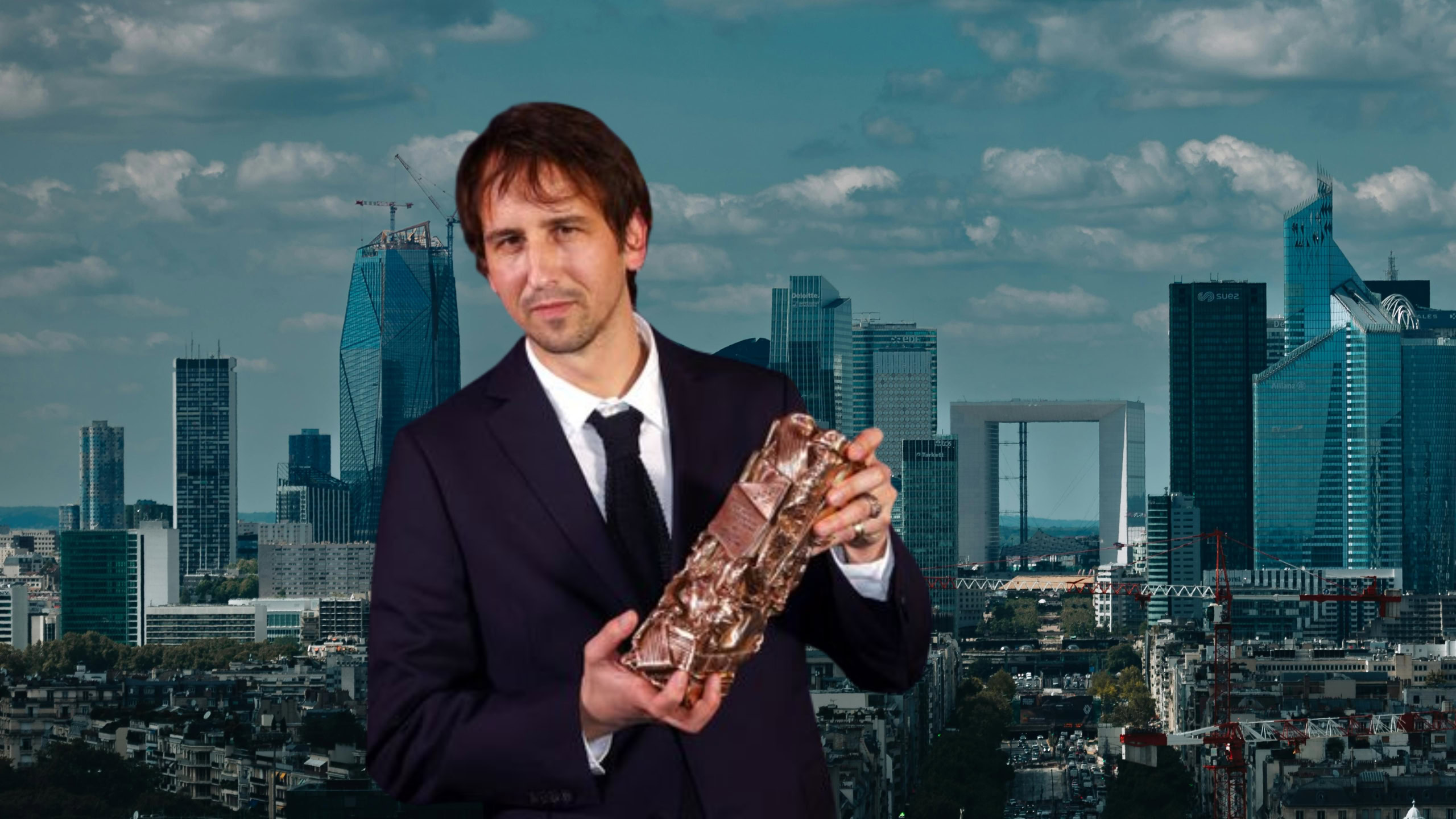
From preparatory classes to the César Awards, via Jouy-en-Josas, La Fémis, and the Ministry of Culture, Stéphane Demoustier has followed a path that is both winding and perfectly coherent. The filmmaker has just released his fifth feature film, The Unknown of the Grande Arche, which won two César Awards. An encounter.
Every story has a beginning: “I absolutely wanted to leave Villeneuve-d’Ascq.” Born in this town of 60,000 inhabitants near Lille, which he describes as “a peri-urban area” lacking appeal and far from any cultural vibrancy, Stéphane Demoustier did everything he could to escape it. In this family of shopkeepers, where “there are no artists or liberal professions,” his future seemed mapped out. A strong student, he followed the expected path and finally left his hometown to attend preparatory classes at Lycée Franklin in Paris. “I went to HEC almost as a continuation of my studies,” he summarizes. But this almost automatic choice led to an unexpected shock: Paris. “I couldn’t believe how beautiful this city was!” he recalls, still moved. The architecture, the perspectives, even the opulence of certain neighborhoods—everything struck him. In retrospect, it may have been a defining moment.
On the Jouy-en-Josas campus, the experience was more mixed. He recalls a sense of solitude, “somewhat gloomy” weekends, far from the Parisian life he had discovered during his prep years. He eventually shared an apartment in the 15th arrondissement, commuting back and forth by motorbike. Still, he retains a deeply sensory memory of his three years at HEC. “When walking down toward the lake, I would think how privileged this place was.” The campus, its trees, its landscape: “a very beautiful place,” where he insists he felt lucky to be.
Odd jobs and wandering years
But upon graduating, no clear vocation emerged. From his years at the Grande École, he remembers a talk by the then-head of Universal, who spoke about “the talent of spotting talent,” as well as a theater troupe performing Molière. “I thought: what an extraordinary life!” The desire was there, diffuse, but still shapeless. After graduating, he turned to Sciences Po, driven more by intellectual curiosity than strategy. Then came a drifting period—almost three years in suspension. In his twenties, Stéphane took on a series of odd jobs: video rental clerk, night watchman, temp assignments in a large hotel near the Champs-Élysées. This wandering, between small jobs and unexpected situations, fed his imagination. “I thought: it’s enjoyable to watch films, it’s enjoyable to write—and I even wrote poetry—but there was no professional plan,” he later admitted.
“I have a friend who, I think, felt a bit sorry for me. He said: ‘At the Ministry of Culture, they’re looking for someone. With your Sciences Po and HEC background, it should work.’” And so, almost by chance, he ended up in the architecture department of the Ministry of Culture, working with a passionate project officer. “She was trained as an architect. I would write bits of speeches for her or prepare small technical notes.” At the same time, he made it a point to attend two cinema screenings a day. Gradually, the two worlds converged. He then joined La Fémis, trained in production, and created a production company, Année Zéro, with a friend from preparatory classes. With Guillaume Brac de la Perrière (H.01), they began directing and producing. This time, the choice was deliberate. “That’s when I became certain—and strongly wanted—to make it my profession.”
Filming architecture, telling power
Following the critical success of his previous film Borgo, which had already earned Hafsia Herzi a César for Best Actress, Stéphane returns with The Unknown of the Grande Arche, a film that is at once political, aesthetic, and deeply human, awarded two César Awards this year.
At the origin of the project lies a fascination with an extraordinary destiny: that of Johan Otto von Spreckelsen, the architect behind the Grande Arche at La Défense. “This man’s story is incredible,” he explains. But beyond the individual story, it opens up a broader reflection. “Architecture raises aesthetic questions, but also political ones.” Building a public structure means expressing a vision of the world, a relationship to power and society. The film gives substance to these tensions, carried by an international cast: Danish actor Claes Bang (lead actor in The Square, Palme d’Or 2017), striking in the main role; Quebec’s Xavier Dolan, delivering both precision and flawless French; and the inimitable Michel Fau portraying François Mitterrand.
Demoustier notably captures the disconnect between an individual and a system. “It’s the story of a man who struggles to connect with his interlocutors.” Even physically, everything reinforces this gap: Claes Bang’s height—1.94 meters—becomes a narrative element. “The fact that he is so tall instantly conveys something.”
At the heart of the film lies a structural opposition between idealism and pragmatism. On one side, a pure, uncompromising vision—the cube imagined by architect von Spreckelsen; on the other, the ability (or inability) to adapt to reality, political shifts, or financial constraints. A tension that subtly denounces the compromises of our time. “An architect’s vocation is to sublimate an idea into reality. Today, we are orphans of political vision,” says Stéphane, reflecting nostalgically on the major projects of the 1980s.
Creating means making choices
At its core, whether in architecture, cinema, or entrepreneurship, the process remains the same: starting from an idea and confronting it with reality. “These are collective arts,” emphasizes Stéphane Demoustier. “You start with an idea to bring it into existence.” And this, despite constraints of budget, timelines, teams, and governance. Rather than resisting them, the filmmaker-producer almost embraces their necessity. “If you are resistant to constraints, you shouldn’t do this job.” Shooting schedules, team size, technical means—every choice matters. “All economic decisions have artistic consequences. The two are intrinsically linked. You spend your time making trade-offs.” With one guiding principle: “Never betray the core idea.” Around this core, everything can evolve, adapt, transform.
The balance achieved in The Unknown of the Grande Arche allowed Lise Fischer to win the César for Best Visual Effects, thanks to an approach that was both inventive and authentic—bringing the monumental construction site back to life through a meticulous blend of archives, digital reconstruction, and post-production. As in any organization, success also depends on the strength of the collective. “You have to find your partners. Build your own troupe.” One certainty for him: “My collaborators are often more intelligent than I am in their respective fields.”
A campus to reinvent, a spirit to preserve

Published by Daphné Segretain