

Campus project: “An iconic place to shape the world of tomorrow”

In the making for several years, the modernization of HEC Paris’s Jouy-en-Josas campus addresses today’s needs in teaching, collective reflection, and knowledge creation—while embodying a strong commitment to sustainable construction and environmental responsibility. Éloïc Peyrache, Dean of HEC Paris, explains the ambitions behind this major project.
What was the genesis of HEC’s current campus modernization project?
This has been a long-standing ambition. We’ve often discussed the need for a profound transformation of the campus, but that reflection was put on hold during the Covid crisis. In May 2023, we reignited the initiative by launching a call for tenders, which led to four teams being invited to participate in an architecture and development competition.
After eighteen months of competition, we selected a consortium led by developers Sogelym Dixence and Linkcity, working with several architectural firms that bring together all the expertise required for a project of this scale. Among them, Snøhetta—famous for the Oslo Opera House and the Bibliotheca Alexandrina—will contribute a distinctive architectural signature. The NeM agency, known for its renovation of the Bourse de Commerce – Pinault Collection, will collaborate with Pierre-Antoine Gatier, France’s Chief Architect for Historic Monuments (ACMH), who will play a key role in preserving the site’s heritage buildings.
The chemistry between the members of this team was decisive. It’s a real asset for carrying out a project that will unfold over many years. We chose the team that best met our current needs while offering great flexibility—because a campus is not built for five years, but for decades.
Why this determination to renovate the campus?
The campus is not an end in itself; it serves the School’s strategy. Sixty years ago, HEC settled in the exceptional setting of the Jouy-en-Josas park to create an “American-style” campus. That decision was foundational—it transformed the School’s trajectory. It became a key factor in HEC’s rise as one of the world’s leading academic institutions, attracting top students and faculty from around the globe.
We want to continue that momentum while confidently looking ahead. Lifelong learning plays an increasingly central role in society—and even more so at HEC, since everyone is called upon to keep learning throughout their career. It’s therefore essential to have a place where today’s and tomorrow’s leaders can gather to prepare for the major transformations shaping their industries and the world.
The societal challenges ahead are immense. HEC must remain an emblematic place where the world of tomorrow is conceived—where policies are evaluated and solutions co-created among researchers, students, business leaders, and experts. Rethinking the campus became essential to meet new needs: encouraging exchanges among our different communities (faculty, students, executives, experts…), supporting pedagogical innovation, strengthening the link between theory and practice, and more fully reflecting our values of excellence, diversity, and entrepreneurship—the core of HEC’s identity.
In what way was the existing campus no longer suited to today’s learning conditions?
The campus is an extraordinary asset and a place rich in history. It embodies a large part of HEC’s identity and inspires deep attachment among our students and staff. However, its current layout reflects another era: the site, which spans more than 100 hectares with a forest and a lake, now lacks a true center and spaces for interaction. The physical dispersion of buildings creates distance between communities.
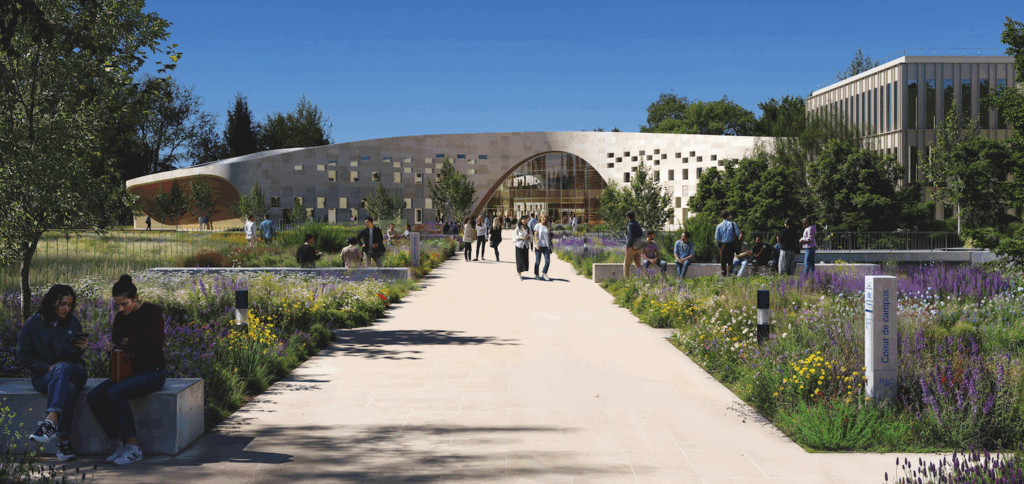
That’s why we wanted to create a genuine campus hub—a place for meeting, exchanging, and innovating together. A place where people can connect over coffee, in an innovation space, or during events. To embody this central heart, we envisioned a landmark building—instantly recognizable in France and abroad—reflecting HEC’s entrepreneurial and collaborative spirit in its architecture.
Moreover, HEC has largely developed on the upper part of the campus, where the facilities dedicated to executive education no longer match our ambitions. We also needed an emblematic space to host global leaders in an environment conducive to learning, reflection, and action. Renovating and transforming the Château and its common areas quickly became an obvious step.
At a time of all-digital and “full remote” work, isn’t this desire to create a physical center counterintuitive?
Quite the opposite. The rise of digital tools and remote interactions makes it even more crucial to invest in exceptional physical spaces. The HEC experience cannot be reduced to the virtual—it thrives on encounters, dialogue, and collective emulation within an environment that stimulates creativity and innovation.
The campus must become a place of convergence—where students and professors from Sydney, New York, or São Paulo meet to imagine solutions to global challenges, not only for tomorrow but for the next fifty years.
That’s why flexibility is at the core of the project. We want spaces that can evolve with future teaching practices. No one can predict exactly what tomorrow’s learning methods will look like, but one thing is certain: the richness of human interaction will remain essential.
The campus will embody a synergy between human connection, digital technology, and artificial intelligence—designed to attract and train the brightest minds.
This transformation also comes with certain constraints tied to heritage preservation, since several buildings are listed as historic monuments…
Indeed, part of the built heritage—most notably the Château—is protected as a historic monument. This status carries a special responsibility: we must combine architectural modernity with respect for the past.
The Château’s renovation has been entrusted to Lucie Niney, cofounder of the NeM agency, working closely with Pierre-Antoine Gatier. Their expertise will ensure a restoration worthy of the site’s historical significance, seamlessly integrated into the future campus.

The HEC campus also includes a forest and a lake. What role will nature play in this new project?
Nature is one of the site’s greatest assets. Our campus is often recognized as one of the most beautiful in the world, thanks to its exceptionally green environment. We therefore asked the architects to incorporate this landscape dimension from the start.
The landscape design, led by the Michel Desvigne agency, aims to enhance and celebrate this natural heritage: some parking areas will be de-paved, hundreds of new trees will be planted… Once again, the idea is to evolve within a truly unique setting. Being a “green campus” means more than having trees—it means recovering rainwater, recycling materials, producing green energy, and reducing resource consumption. We’ve set our sights on the highest environmental certifications, because we want the campus to become a benchmark for environmental responsibility.
More than a real estate project, this is a promise to future generations—a place where academic excellence, respect for life, innovation, and openness come together. A place to learn, and to make a positive impact on the world.
Photographs : © Ciprian Olteanu / Waverline
Illustration : © SORA

Published by Daphné Segretain