
“Refusing to Stay Silent”: Shirin Golkar, Between Entrepreneurship and Resistance
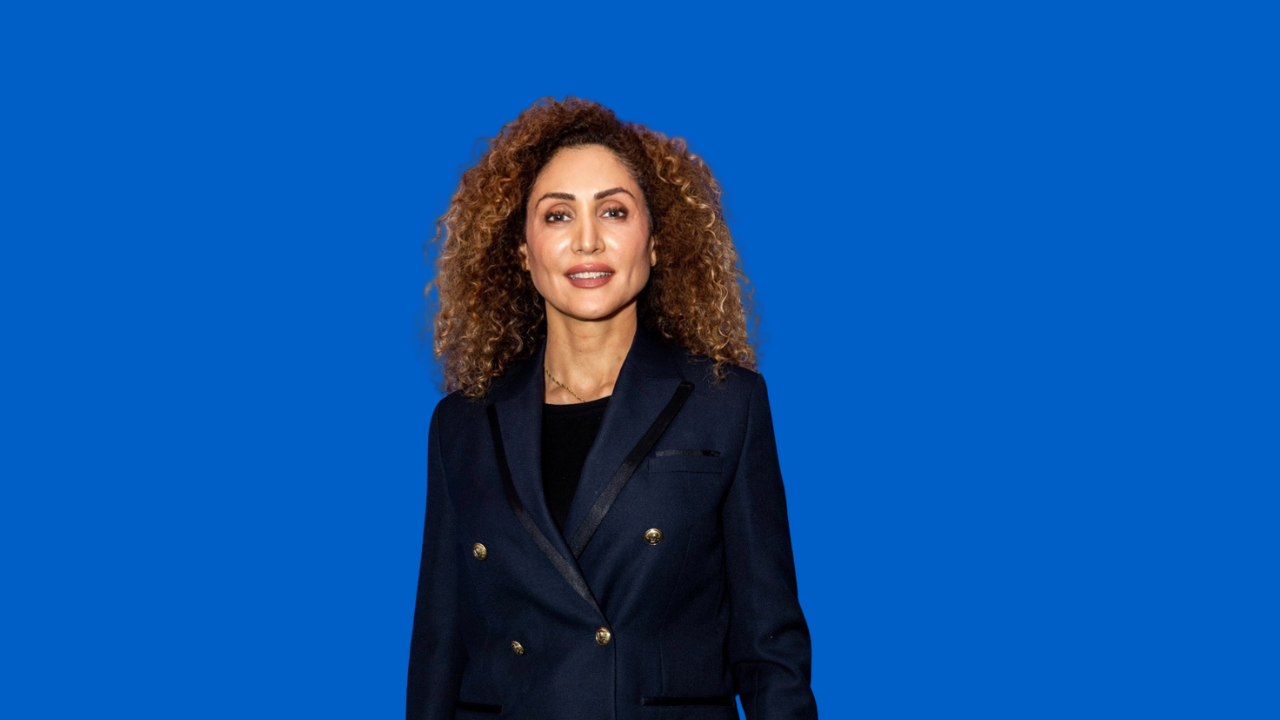
When we speak with Shirin Golkar (EMBA ’24), Iran is once again plunged into a period of extreme violence. Communications are cut, the internet is blocked, and news arrives only in fragments — when it arrives at all, and rarely reassuring. Shirin was in Iran at the time, visiting her family, when the twelve-day war broke out. She left the country with her parents by crossing the Iranian border, before returning to France. Her friends and extended family have stayed behind. For several days now, her WhatsApp messages have not gone through. One tick, frozen. Silence.
“My closest friends are in Tehran. My aunts, my cousins too. I have no news. They don’t have Starlink.” This silence is the starting point of a rare testimony: that of a woman with an international trajectory, a committed entrepreneur, who has chosen to speak — not for herself, but for those who no longer can.
Growing up in Tehran, leaving to understand
I am Iranian. I was born in Tehran and grew up there until the age of 17. My father was an entrepreneur and businessman with no ties to the regime. I studied at an international high school before leaving Iran in 2000 to pursue my studies in France.
“I arrived in Paris alone. At the time, there wasn’t really an Iranian community of my generation. The Iranians we encountered were mostly refugees from the Revolution and political asylum seekers in France. I built my life in Paris, far from my country.”
I lived, studied, and worked in Paris for fifteen years. Until 2015. That year, the partial lifting of international sanctions against Iran opened a window: economic opportunities, new demand, and prospects of reconstruction. I decided to return.
The return — and the shock
I joined a major oil company, Parsian Oil & Gas, in the international relations department. The experience was brief. “It was very closed. Very patriarchal. After living so long in France, some rules were impossible to accept. I couldn’t shake hands with a man. I had to wear a very strict veil. It wasn’t me.” The problem was not only ideological. It was structural: a lack of professional freedom, an absolute glass ceiling, and the systematic exclusion of women from networks of power.
Entrepreneurship as a lever for emancipation
At that point, I was approached by the Swiss Chamber of Commerce. I began working with them at the end of 2017, in close coordination with the Swiss Embassy and later with several international organisations, including the UN and UNICEF. By 2018, one reality had become clear. “I saw brilliant women — engineers, manufacturers, designers — but without access to networks, financing, or export markets. And chambers of commerce have enormous power to open doors.”
I founded a programme dedicated to Iranian women entrepreneurs, embedded within chambers of commerce: international support, access to investment, mentoring, training, and the structuring of professional communities. This was not framed as a political project. “That would have been dangerous. But in an authoritarian system, economic independence is already a form of power. When women earn, export, and build businesses, they gain leverage — even without slogans.”
Hunger as the real fault line
What is happening today cannot be understood without economics. According to economists quoted recently in the Financial Times, by late 2024 a family of four needed more than half of an average worker’s income just to cover food. Rent alone was consuming around 60 per cent of salaries for most urban households, and for lower-income workers food costs reached as much as 70 per cent of monthly income. One Tehran-based economist described the food-price crisis as having “no precedent since World War II”. When the price of a kilo of chicken approaches European levels in a country where wages are only a fraction of those in Europe, it stops being an inflation story and becomes a political one. This is why today’s protests are different. They are not driven by ideology. They are driven by hunger, humiliation, and exhaustion.
“Woman, Life, Freedom”: a movement misunderstood abroad
The “Woman, Life, Freedom” movement was widely framed abroad as a feminist uprising. I only partially agree. “It was reduced to a cultural issue — the hijab, personal freedoms. Inside Iran, it was inseparable from economic injustice and class hypocrisy.” In 2022, morality police were arresting everyone — broadly and violently, not selectively. Poor women felt this injustice first: in the streets, in the workplace, in daily life. “Gender repression and economic inequality are not separate issues in Iran. They reinforce each other.”
Cut off from networks, cut off from the world
For weeks now, everything has come to a halt. No more events. No more training. No regular contact. “They no longer have access to the internet. And we no longer have news.” Information arrives through colleagues equipped with Starlink. The testimonies are chilling. “I spoke to a colleague today. She told me her clothing business will go bankrupt if the internet does not come back. Her entire business runs on Instagram. She sells only through Instagram. Many families depend on this. When the internet is shut down, Iran loses millions every day.” The figures vary. The regime speaks of 2,000 deaths. Human rights organisations cite much higher numbers. I do not give a precise figure. “But they have killed many people.”
The lock of power
Why does the regime still hold? Because there is no internal fracture at the top. The Islamic Revolutionary Guard Corps (IRGC) is highly cohesive and controls large parts of the parallel economy — oil sold under sanctions, smuggling networks, and currency flows. A small elite benefits while the majority becomes poorer. Without an internal split and without organised leadership, repression becomes the default response.
No leader — and the danger of false expectations
“There is no unifying leader with a credible transition plan. No Iranian Nelson Mandela. The diaspora is fragmented and often disconnected from realities on the ground.” When people are hungry, abstract ideological debates lose meaning. “They want normalcy. Dignity. The ability to feed their children.”
A call to the HEC community
What can the international community — and more specifically, the HEC community — do? I am clear: speak, relay, do not forget. “I’m not asking for abstract declarations. I’m asking that we tell what is happening. Why we are here. How many people have died. That this cause becomes everyone’s cause.” I mention the role of cultural figures such as Jafar Panahi, who continue to bear witness. I call for concrete mobilisation: articles, social media amplification, and sustained attention. “Every day that passes kills people. And the longer the silence lasts, the more the violence continues.”
Not looking away
Before concluding, I share one story. A seventy-year-old woman — an educator who spent her life building schools for underprivileged children — sent a simple message on Telegram: “Tonight, we are going to protest.” There has been no news of her since. Arrested. Disappeared. “She devoted her life to doing good,” I say quietly. “And she vanished. Imagine the others.” Not staying silent is no longer a choice. It is a responsibility.

Published by Daphné Segretain