
Mayada Adil (M.27), student and resistance fighter
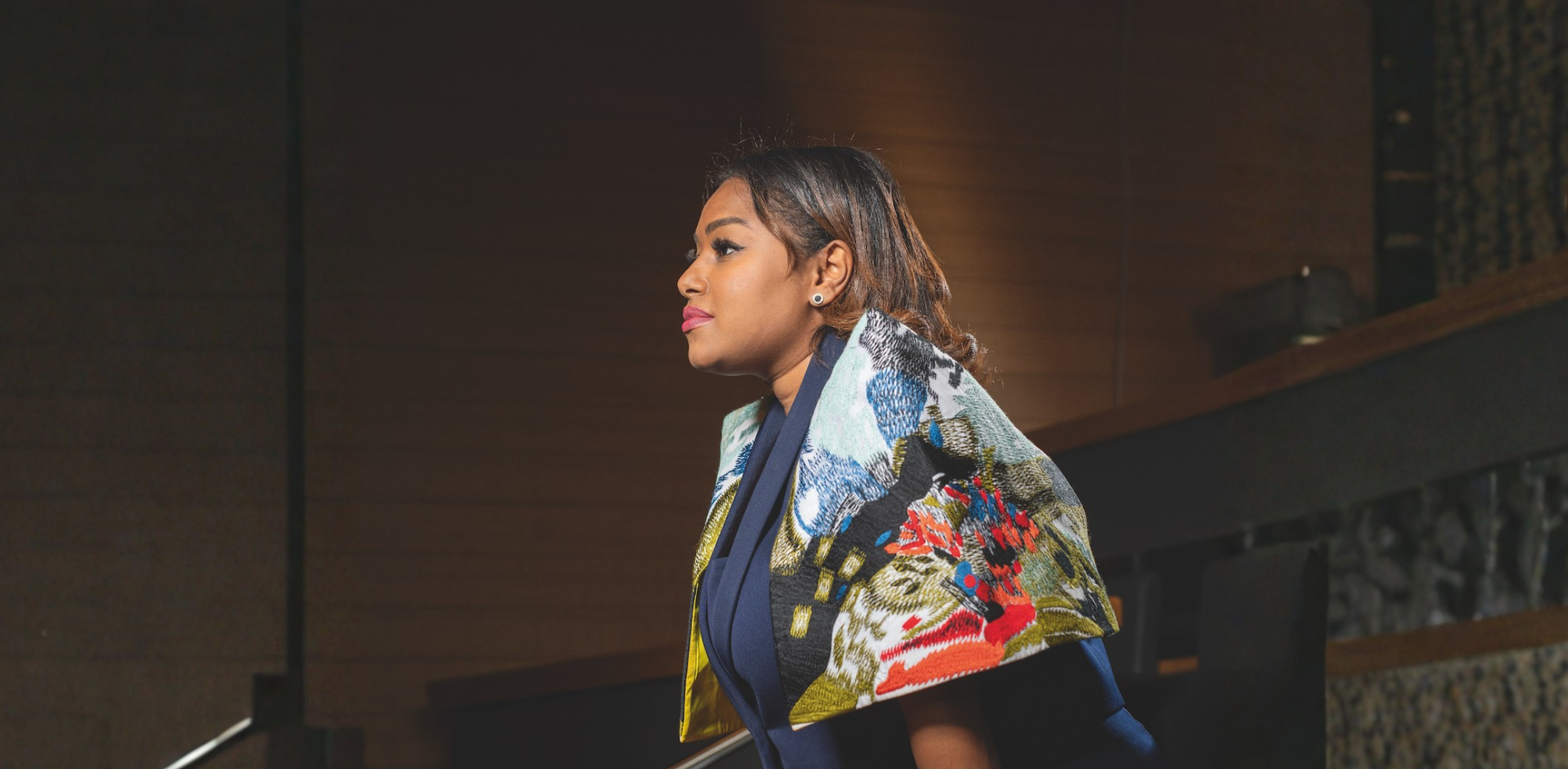
Fashion designer, women’s rights activist, doctor in refugee camps, and student — Sudanese Mayada Adil (M.27) embodies commitment in action. Portrait of a voice for change.
Exile is a notion Mayada Adil has long been familiar with. During her childhood in Khartoum, Sudan, she had to travel to Saudi Arabia every time she wanted to see her father, who had been banned by Omar al-Bashir’s regime for having served in the civilian government before the 1989 coup. At the age of eight, she moved permanently to the oil kingdom, leaving behind part of her family and friends—but also the subjects she loved most, such as theater, English, and French, since performing arts and Western languages were considered contrary to religious morals there.
“Everything was haram, forbidden… At first, it was difficult to adjust. But since we were migrants, my parents put a lot of pressure on my brother, my sister, and me to achieve good grades. So, I had to become top of my class!”Her determination paid off: she not only topped her class but also ranked first nationwide in high school. Her parents soon encouraged her to pursue prestigious medical studies. “I was actually more interested in IT and fashion… But I followed their advice—they had that typical expatriate mindset of wanting to shine at all costs in their host country,” she recalls.
Return to Sudan
To follow that path, Mayada had to return to Sudan, where medical schools enjoyed a stronger reputation at the time. It was 2011, and she hadn’t been back to her home country for ten years—and things had changed. She was first shocked by how women were treated, something she hadn’t realized as a child. Under al-Bashir’s authoritarian regime, their place was said to be “in the kitchen,” a patriarchal vision that had led to the arrest of journalist Loubna Ahmed al-Hussein for wearing trousers. She was also deeply moved by the fate of South Sudanese people. Once her neighbors and fellow citizens, they had become ostracized—or had simply fled—after South Sudan’s secession in July 2011.
These successive realizations awakened another vocation in her: to help others. She soon specialized in gynecology and, through the International Federation of Medical Students’ Associations (IFMSA), traveled to rural areas to support women who were victims of genital mutilation, gender-based violence, or rape. There, she saw first-hand the extent of inequality, especially among women with no income or access to healthcare. Mayada then joined the World Health Organization (WHO) to reach as many people as possible.
“I needed that to feel connected to the Sudanese people—I couldn’t just go on with my studies,” she says. In 2013, when civil war broke out and South Sudanese refugees poured back into Sudan, the WHO sent her to work in refugee camps. There she built bonds of friendship with the women she met. “I would talk to them about my passion for fashion, and they’d say they could be my models! They helped me realize that fashion could be a powerful form of protest.”
Models and subversion
With that idea in mind, she set medicine aside in 2017 to dedicate herself to fashion. To do so, she had to relocate. “It was unthinkable to do that in Sudan, where the regime forced women to dress traditionally. So, I moved to Kenya. I was afraid that decision would change my life—and it did!” she recalls. From the Sub-Saharan country, she launched her brand, simply called Mayada, and quickly began working on her first collection, Nubian Queen.
Through her designs, she drew inspiration from the Nubian queens who ruled around the third century BC. By evoking an ancient era when her people were led by women and when North and South were united, she hoped to inspire contemporary Sudanese women to demand greater rights. Working with Sudanese refugee women to create her garments, she also helped them earn an income.
The color white plays a central role in her work—it symbolized resistance during the British occupation, dominates Sudanese cities, and represents the kindness of Sudanese women, “a people with white hearts.” As for the fabrics, she sourced them by repurposing materials wherever she could, making her label at once subversive, ethical, and sustainable. “I was very proud of my work, but my parents didn’t see it that way. They couldn’t understand how I could give up a medical career for this—and they didn’t grasp the power of the message.” Sudanese youth, however, embraced her bold designs and her activism. Her growing popularity soon became a liability: as protests spread across the country, she was viewed as a troublemaker. At the end of 2018, she decided to flee.
Women’s mobilization
Invited to Paris to present her collections at the Africa Fashion Reception (a pan-African fashion initiative then supported by UNESCO), she set her sights on France. From the capital, she followed the 2019 Sudanese revolution. “Given the situation, I couldn’t go back. But being abroad allowed me to get involved in the protest,” she explains. She organized demonstrations and took part in various activist actions. With a group of fellow activists, she unfurled in front of the Sudanese embassy a large Sudanese flag made from women’s underwear, alongside a banner reading ‘Women’s bodies are not battlefields.’
“It was a reference to how the regime’s militiamen treated female protesters: after raping them, they would wave their underwear as a trophy. I wanted to honor these heroines.” The fall of Omar al-Bashir’s regime in April 2019 stemmed largely from this wave of women-led mobilization, which intensified after food prices soared. “It’s a great irony, because it was in the kitchens—the very place the regime wanted to confine women—that the revolution was born,” she says with a smile.
From the UN to HEC
Mayada’s activism caught the attention of the French media and led to numerous invitations to speak about women’s rights in Sudan. In 2021, while pursuing a master’s degree in Human Rights and Humanitarian Action at Sciences Po, she joined the French Presidential Council for Africa, created by Emmanuel Macron, and directly addressed the president, urging him to act for women who are victims of genital mutilation in France.
The following year, she was named one of the United Nations Young Leaders for the Sustainable Development Goals. “That was like a dream come true for me,” she admits. “I remembered how, when I first started helping women in refugee camps, I dreamed of becoming a UN Goodwill Ambassador. Well, it’s not the same title, but the mission is the same—to defend my people on the international stage.” For two years, she lived between Paris, Geneva, and New York, delivering powerful speeches at the UN Security Council and General Assembly.
Now “just an ordinary citizen” again, she has enrolled—thanks to the HEC Imagine Fellows scholarship—in HEC Paris’s Master in Sustainability and Social Innovation (SASI). Her goal, once again, is to help rebuild Sudan, now ravaged by a devastating civil war between the regular army and a paramilitary militia. The conflict has claimed over 150,000 lives and displaced around 13 million people—nearly a third of the population. “I believe that businesses will play a key role in bringing Sudan back to life—that’s the path I want to explore now. I’ve worked a lot in NGOs and the public sector, but I wanted to learn more about the private sector. And HEC is probably the best place to do that.”
Photography : Ed Alcock

Published by Daphné Segretain