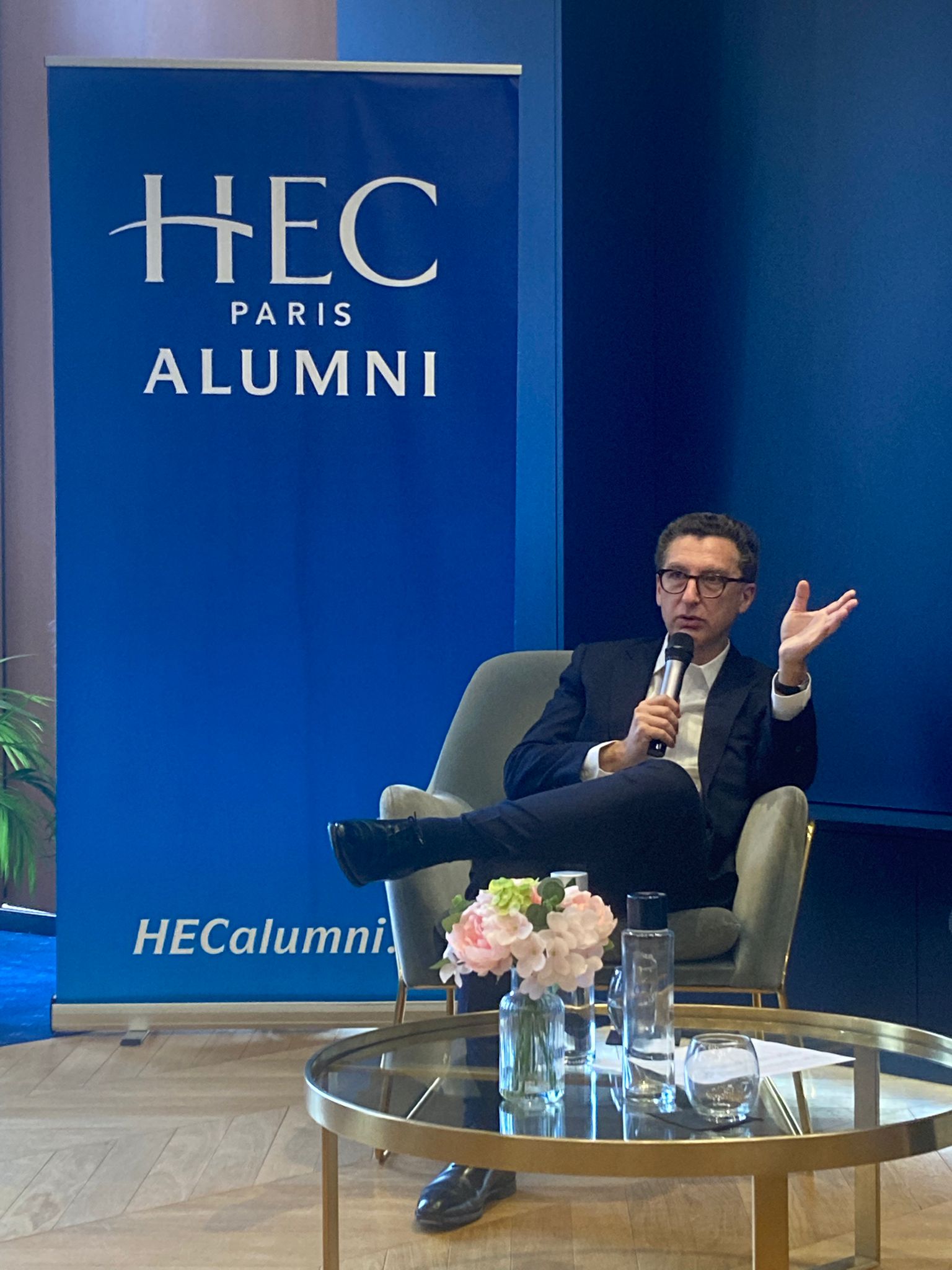
On January 28, Jérôme Wagner (H.85), President of the HEC Media & Entertainment Club, thanks to our fellow alumnus Jean-Michel Garrigues (E.89) who made the connection, welcomed Maxime Saada (MBA.94), Chairman of the Management Board of Canal+, over breakfast. In front of alumni and other industry professionals, he examined in depth the issues of financing, competition, and international development. A look back at an exceptional cathodic moment.
A leading media player
Canal+ is now a global player in media and entertainment. “With the acquisition of the leader in pay-TV in Anglophone and Lusophone Africa, MultiChoice, Canal+ now has more than 40 million subscribers in 70 countries.” Despite pressure from streaming platforms, Canal+ intends to remain a cultural and technological player capable of shaping the audiovisual landscapes of the countries in which it operates.
Facing the streaming giants
International expansion and competition represent major challenges. Streaming platforms, led by Netflix, are transforming viewing habits. “We know that we still have a significant reservoir of growth, but we must continue to attract viewers and convince them that Canal+ has value,” explains Maxime Saada, elegant and at ease in the Association’s premises. The channel seeks to maximize the exposure of its content, particularly among younger generations, to strengthen the positive perception of the brand and stimulate subscriptions. A strategy that is paying off in a saturated market where every viewer counts.
When economics dictate creation
Since Maxime Saada took over as head of Canal+ in 2015, the emblematic player in the French audiovisual landscape has undergone a profound transformation. “When I looked at the viewers of Le Petit Journal or Le Grand Journal, did that motivate them to subscribe to Canal+? Absolutely not. It was simply an economic issue,” he confides. If certain programs were discontinued, it was not a question of talent or content, but one of economic profitability: “It’s not a question of talent, because talent is still there: if you give today’s budget to the historical producer of Le Grand Journal, he would remake Le Grand Journal even better. It’s a question of economic profitability.” For Maxime Saada, profitability lies at the heart of the strategy: Canal+ cannot simply attract an audience; it must convert that attention into paid subscriptions.
The art of bringing talent to light
Canal+ has always been a talent incubator. Yann Barthès, Léa Salamé, Florence Foresti: all began or were revealed thanks to the channel. “Today, television struggles to bring out new talents, but Canal+ remains an essential incubator,” emphasizes Maxime Saada. Beyond economics, this ability to identify, train, and launch new faces is a major strategic and cultural asset, difficult to replicate.
Sharing access codes to attract subscribers
Unlike platforms that tighten access, Canal+ has chosen to dare to share access codes. A humorous campaign featuring Jonathan Cohen, Kad Merad, and Florence Foresti encouraged subscribers to share their access, with the aim of attracting new viewers. “This advertising campaign worked very well.” An original approach that reflects the channel’s desire to attract rather than punish.
Cybersecurity and data: the new ramparts
In a hyper-connected world, Canal+ must also protect itself. The digital era demands vigilance and innovation: cyberattacks, data management, and artificial intelligence are now at the heart of the strategy. “We must be humble. We are never completely safe. But we have put robust teams in place and take this issue very seriously,” assures the chairman.
Content protection, user security, and the intelligent use of data are all strategic challenges in remaining competitive against international giants.