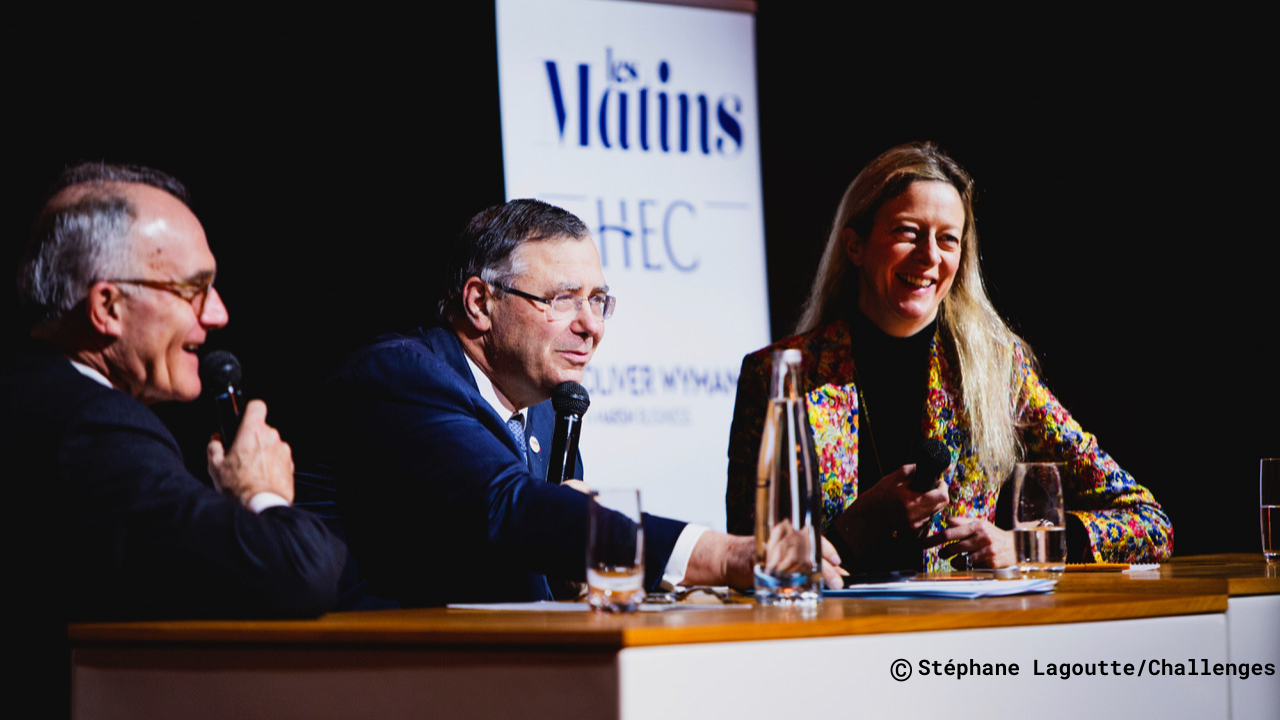

On February 20, the 346th Matins HEC event filled the Pavillon Vendôme to capacity to welcome the CEO of TotalEnergies. Introduced by Hortense Roux (H.05), President of HEC Alumni, and Bruno Despujol, Partner at Oliver Wyman, Patrick Pouyanné was interviewed by Pierre-Henri de Menthon, Editorial Director of Challenges. A deep dive into the turbulence of the global energy industry.

Burning issues: financial results and the climate lawsuit

TotalEnergies has just announced a 17% drop in its annual net income. Nothing alarming for Patrick Pouyanné: “I’m more interested in cash flow generation than in net income, which depends on hydrocarbon prices.” Cash flow declined by only 7%, driven by growth across all business segments: oil, gas, and electricity. The markets share this assessment: the stock rose by 4% following the announcement. Compared with its competitors, TotalEnergies remains the most profitable major oil, gas, and energy company. The company is also facing significant legal developments, with the first major climate lawsuit brought in France against an energy group by environmental NGOs. “The Duty of Vigilance law was initially intended to address companies’ responsibility regarding their subcontractors. Some NGOs are now trying to extend its scope to climate issues through this lawsuit against TotalEnergies,” Patrick Pouyanné points out. At the heart of the debate is responsibility for indirect emissions, known as Scope 3. “TotalEnergies is responsible for reducing its direct emissions (Scopes 1 and 2). We have reduced them by 30% since 2015 and will continue to do so. But are we responsible for our customers’ emissions?” he asks. Behind the case, he sees an attempt to force major energy companies to abandon oil and gas—something he considers unrealistic: “Society still needs them today.” Confident, he adds, “If we are convicted, we will appeal… and for a long time.”

Electricity, a cornerstone of diversification

Diversification lies at the core of his strategy. TotalEnergies has scaled back its investments in biomass and biogas to focus more heavily on electricity. The group aims to generate 20% of its business from electricity by 2030 (compared with 10% today), and ultimately to produce €3 billion in cash flow from this segment. Investments in this area remain substantial, at around €3 billion this year. The decrease from the €4 billion invested in previous years is neither a disengagement nor the result of a so-called “Trump effect,” but rather a return to a normal pace of investment.

Last November, TotalEnergies even strengthened its position by acquiring a 50% stake in a European electricity platform owned by Daniel Křetínský for nearly $6 billion. “People say electricity isn’t profitable, but that’s not true: the market is shifting,” Pouyanné asserts. Above all, this business provides a key advantage: resilience in the face of oil and gas price volatility.

While American groups such as Chevron remain focused on hydrocarbons, and European players like Shell or BP slow down their diversification efforts, TotalEnergies is staying the course. “We are the last to pursue this strategy, which creates a different value proposition.” While American groups such as Chevron remain focused on hydrocarbons, and European players like Shell or BP slow down their diversification efforts, TotalEnergies is staying the course. “We are the last to pursue this strategy, which creates a different value proposition.”

Energy markets: caution and realism

The group’s recent listing on Wall Street gives it access to a broader base of American investors, who are playing an increasingly significant role in its shareholding structure, and makes acquisitions across the Atlantic easier. The United States already accounts for 15% of the group’s business activity, driven by LNG and electricity. In a world dominated by Sino-American rivalry, navigating between the two powers has become a strategic exercise. “There is more energy and more resources in the United States than in China, but when it comes to renewables, it is difficult to do without Chinese products.” To limit political risk, the group applies two principles: geographic diversification and strong local anchoring, so as not to be perceived as an instrument of influence. “TotalEnergies is the only non-Anglo-Saxon major, and it leverages this unique position in a number of regions.”

Asked about the evolution of oil prices, the CEO refuses to make any predictions: “I don’t have one. Nevertheless, we built our budget on a $60-per-barrel assumption.” Global demand has continued to grow by around one million barrels per day each year (or +0.9%) over the past fifteen years, but the previous increase in investment has expanded supply, creating rather bearish fundamentals. Of course, any geopolitical shock could still change the equation.

Questions from the audience — talent, AI, geopolitics

Numerous questions were raised from the audience, particularly about talent retention, which does not overly concern Patrick Pouyanné: at TotalEnergies, staff turnover stands at just 0.6%, and the electricity and renewables division is highly attractive. While the proportion of women managers and executives has increased from 20% to 30% over the past ten years, the main challenge remains geographic diversity: “We are still too French-centric,” he regrets, noting that 60% of the top 1,000 positions are held by French nationals.

Regarding the Yamal LNG project, in which the group still holds a stake, TotalEnergies has taken note of the European Union’s intention to ban imports of Russian gas. He believes that by 2027, Europe could do without Russian LNG without a price increase, thanks to global supply.

Matins HEC with Patrick Pouyanné, Chief Executive Officer of TotalEnergies
Finally, on climate issues, Patrick Pouyanné advocates for a high carbon price to steer behavior, arguing that carbon capture and storage technologies will not truly take off until the price per ton reaches €150. In his view, the transition requires coherent public policies: fewer price subsidies and more tax incentives to encourage investment.

A clear strategic direction

Throughout the discussion, one constant emerged: the determination to pursue a diversification strategy combining hydrocarbons and electricity. In a sector facing unprecedented geopolitical, legal, and climate pressures, Patrick Pouyanné embraces a pragmatic approach: supporting the transition without abruptly breaking away from today’s energy realities.

Matins HEC with Patrick Pouyanné, Chief Executive Officer of TotalEnergies

Photo credit : Stéphane Lagoutte / Challenges

Matins HEC are organized in partnership with :

Avatar photo

Published by