

Campus Project: “A structure that creates interaction and collaboration”

“If our physical environment can change us psychologically, then better architecture must be capable of improving society,” Kjetil Trædal Thorsen told Le Temps magazine in 2020. For thirty-five years, Thorsen has co-led Snøhetta, the architecture firm behind the Library of Alexandria, the Oslo Opera House, and the Le Monde headquarters in Paris. For HEC Paris’s Jouy-en-Josas campus, the Norwegian architect has envisioned a new central hub designed to connect the entire site and foster interaction among students.
The renovation project is centered on the creation of a new main building. How did you approach this architectural element?
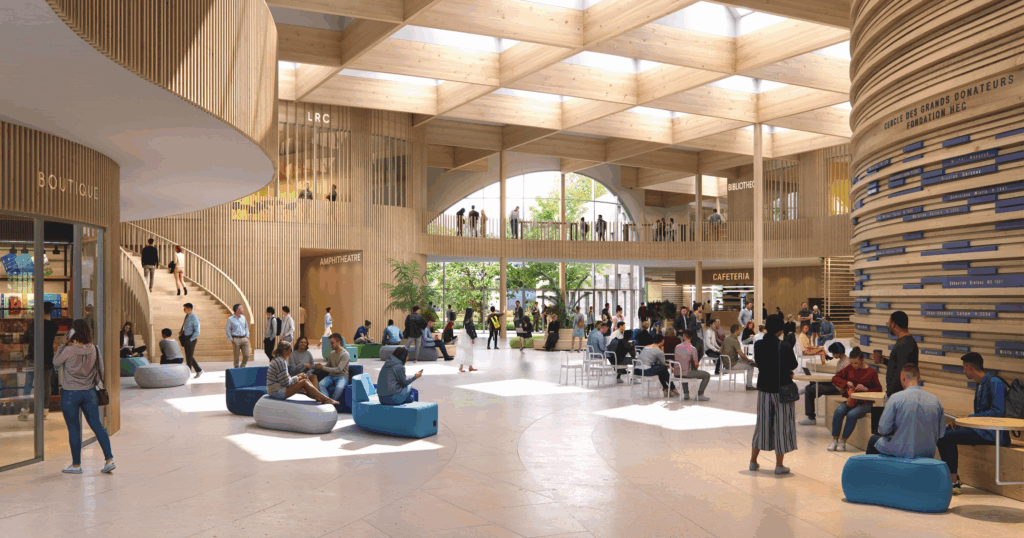
Our main mission was to design a central element that functions as a true connector—something akin to a hand or an octopus. The building isn’t defined by a single use; it is designed to link together all parts of the campus: the historic buildings, the surrounding landscape, and the diverse communities who bring the place to life—students, professors, researchers. Each wing or section creates both a physical and symbolic connection that encourages movement, encounters, and exchange. The goal was to design a convergence point, a place where interactions happen naturally, fostering dialogue across disciplines, nationalities, and generations. This building acts as a catalyst for interaction—a living structure that symbolizes both the history and the future of HEC, where interior and exterior spaces flow together through large glass openings, maintaining a constant visual dialogue with nature and creating harmony between architecture and environment.
How did you integrate natural spaces into the heart of the campus?
Our ambition was to bring nature inside. Of course, you can’t literally move a forest indoors, but through large openings and panoramic views, we’ve created a strong connection between inside and outside—a visual and physical continuity between built spaces and the natural landscape. Green spaces are ever-present, with patios and gardens that allow users to remain in constant contact with nature. This dialogue between architecture and environment lies at the heart of the project—it’s essential to well-being and quality of life on campus.
Does the new building include any modular features?
Yes, flexibility is a crucial aspect—especially for a campus that must evolve over decades. Most of the spaces are designed on two levels, allowing for easy reconfiguration of rooms and functions. Movable partitions make it possible to adapt spaces to changing pedagogical needs. We’re also anticipating new learning modes that go beyond traditional classrooms—learning outdoors, in informal spaces, even while walking through the park.
The building must support these new ways of learning by offering adaptable, open spaces, while remaining connected to nature and the campus community.
The heart of the campus also includes a large auditorium…
Indeed. The auditorium is directly connected to the building’s central area but can be opened or closed depending on needs. This modularity allows it to host major events—graduations, conferences, student gatherings—or be divided into smaller spaces for classes or workshops. It’s a living space, designed to adapt to the diverse rhythms and uses of campus life.
The campus is not only a place of learning, but also a living environment for students. How did you integrate that dimension?
We didn’t want to create spaces solely devoted to learning, but rather places where students feel connected, inspired, and engaged. The central building—with its wide openings onto the landscape and fluid communal areas—encourages meeting, collaboration, and reflection. Nature isn’t just a backdrop; it’s an integral part of daily experience. By bringing natural elements into the built environment, we promote a serene, restorative setting where students can work, think, and reconnect.
Were there specific sustainability requirements in the brief?
Yes—environmental responsibility is central to the campus renovation. Architecturally, we’ve favored natural materials such as wood and stone, chosen for their low carbon footprint, durability, and timeless aesthetic.These materials also help the building blend seamlessly into its surroundings while ensuring optimal energy performance through natural ventilation and local energy production. On an educational level, the building itself becomes a learning tool—a living demonstration of how to combine innovation, environmental stewardship, and quality of life, raising awareness among future leaders by embedding ecological responsibility into their daily experience on campus.
Photographs : © Ciprian Olteanu / Waverline
Illustration : © SORA

Published by Daphné Segretain